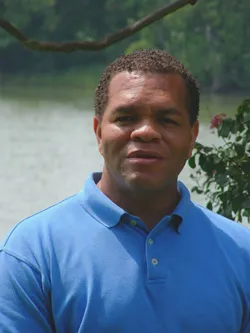
Assistant Professor Karen Leona Anderson's poem "Receipt: Midway Entertainment Presents," originally published in Seneca Review, has been selected for inclusion in the prestigious 2012 Best American Poetry.
Program Information
Ben Click, Chair
Professor of English
240-895-4253
baclick@smcm.edu
Office staff: 240-895-4225
Alumni—where are they now?

Karyn Sailstad (class of 2007) graduated with an English major and a minor in Studio Art. She currently lives in Bath, England, where she is pursuing a Master’s degree in Creative Writing at Bath Spa University and interning with the children’s publisher Barefoot Books.
More
Student Spotlight

Melanie Kokolios's short story "Schadenfreude" has been published in Carve's Spring 2011 online issue and will appear in print in their 2011 anthology at the start of 2012.
This document addresses purely practical concerns, such as how to apply, and fill out paperwork: it’s not intended to help you actually put together your project at an intellectual or creative level. It assumes, moreover, that you’ve already made the decision to pursue an SMP.
As a supplement to this page, look at the College’s SMP page, which contains much information, as well as links to all the forms you’ll need.
Optional: find a mentorYou need a mentor to do an SMP. If your project proposal is approved, and you have not already identified a mentor, the department will assign you one; if, however, you know whom you would like to work with, it can be helpful to get his or her suggestions even as you are putting together your initial plan.
If you don’t already have a mentor in mind, go talk to several professors about the project you’re envisioning (don’t worry if it seems pretty half-baked: at this point, it’s unlikely to be otherwise. And even if you end up not working with anyone you speak to about it, you still may get good ideas from the conversation). In choosing whom to talk to, you may find it helpful to look at the lists of past projects different professors have mentored, and the guidelines some of them give for the kinds of projects they tend to prefer. Try to identify someone who seems interested in the project, who has helpful advice to give you about it, and who seems like someone you’d like to spend a lot of time working with. Although you don’t necessarily have to work with someone you’ve taken a class from before, having done so will certainly give you some idea about that person’s style, his or her critical approaches, and the kinds of feedback he or she gives on written work—all things that can affect your project.
Your SMP mentor is not the same thing as your advisor. While you may work with your advisor, there’s absolutely no reason you have to—and selecting a mentor doesn’t mean you have to become his or her advisee.
Your SMP mentor does not necessarily have to be an English professor: particularly for interdisciplinary projects, students may select a mentor outside of the department, or have both an English and a non-English mentor. Before you do this, however, check with the English Department Chair to make sure you will get English credit for doing so. Depending on how much your project ends up straddling disciplines, you may be required to take four, or even eight, additional English credits to complete your major. If, as your interdisciplinary project develops over the course of the year, it becomes more centrally "English," you may ask your mentor to petition the English department to grant you more credit towards your major. All such requests must be made prior to the commencement of your final semester at SMC, so that you can begin the term registered for the coursework you will need to have in order to graduate.
Don’t be afraid to ask someone to mentor you: that’s part of professors’ jobs, and usually one that they enjoy. Don’t assume, though, that you’ll necessarily be able to work with your first choice of mentor: professors may have other commitments, be going on leave, or feel that they don’t have the expertise to advise you well on the project you’re contemplating. If the first person you approach says no, ask for suggestions about whom to try next—or, if you'd rather, wait to see whether your proposal is approved, and talk to whomever the department recommends that you work with.
Write and submit a Statement of Interest and Preparation to the English Department
Students wishing to do an SMP during the 2010-2011 academic year should plan to submit a Statement of Interest and Purpose (SIP) to the department chair, Prof. Ben Click, no later than Monday, March 22. In order to help students prepare these SIPs, the department will host an information session on Monday, February 1, 2010, and SIP writing workshops the week of February 22 (details forthcoming). We also encourage you to discuss both the decision to do an SMP and the process of generating ideas for an SMP with your academic advisor and/or a potential mentor(s).
Students should keep in mind that the SMP is not required by the department, and that taking a 300- and a 400-level course (or two 400-level courses) is a respectable—and sometimes preferable—alternative to an SMP.
Statements of Interest and Preparation should consist of a one- to two-page, single-spaced, project description. These statements should include the following:
For primarily critical projects:
- a basic description of the scope of the project, including the questions, issues, or general area of study that the student wishes to address;
- an initial list or summary of primary and secondary texts that the student has identified as central to his/her project;
- the student’s initial plan for research (which might include additional reading of critical/theoretical work related to the project, or inquiry into a particular historical period, genre, or author);
- an overview of the kinds of arguments that the student expects to make in his/her project;
- a detailed explanation of the work (both in and out of class) that has prepared the student to undertake the project; and
- the mentor’s name, if the student already has a mentor for the project.
- a basic description of the scope of the project, including the genre(s) in which the project will be written and the expected focus of the project;
- a summary of the primary and secondary texts that the student has identified as influential upon his/her project;
- the thematic and/or stylistic questions that will inform the student’s creative work;
- the student’s initial plan for research (which might include inquiry into the history and practice of specific literary modes, the work of one or more influential authors, background information that will be used to inform the final creative work, and/or a topic illuminated by theoretical/critical debate);
- a detailed explanation of the work (both in and out of class) that has prepared the student to undertake the project; and
- the mentor’s name, if the student already has a mentor for the project.
For projects that mingle critical and creative approaches, the above guidelines should be adapted as appropriate, preferably in consultation with a prospective mentor.
Along with the Statement of Interest and Preparation, each student should also include a writing sample of no less than 5, and no more than 10, pages. Writing samples for critical projects should be taken from an analytical essay, while those students proposing a creative project should include a sample of their work in the genre that they will write their SMP. Students are welcome—and, in most cases, are expected—to submit work written for a course taken at St. Mary’s.
The department will read all Statements of Interest and Preparation prior to advising week. At this time, any students who need help finding a mentor and have proposed projects deemed viable by the department will be matched with the faculty member best suited to their particular project.
Project mentors will convey the department’s feedback to students concerning their SMP proposals; students whose projects have been judged not suitable will have the opportunity to discuss the department’s feedback on their proposals with the department chair, and may, in certain circumstances, be permitted to revise and resubmit.
Register
This is pretty simple: for the first term of your SMP, register for Engl 493. For the second semester, register for Engl 494.
In some cases—if, for example, you're going to be abroad for the first semester of your SMP—you may need to register for both 493 and 494 in the second semester of your project. You also might register for 2 credits in one semester, and 6 in another. Check with your advisor as well as your mentor about this.
In some cases, an SMP may count for the English major even if it is completed in another department (that is, you might register for POSC 493). Many double majors do their SMPs this way. If you want to try this, before you register, before you select a mentor, talk to the Department Chairs in both departments, to make sure you’ll be satisfying all graduation requirements. If you aren’t a double major, but want, say, to register your project as WGSX 493, you only need to speak to the English Department Chair.
Fill out paperwork at the beginning of the semester
At the beginning each semester of your project, you need to fill out an action plan, which is similar to a learning contract. The first semester, the form needs to be signed by you, your advisor, your project mentor(s), and your department chair(s)—then submitted by you to the Registrar by the end of the second week of the semester. The second semester, you only need your mentor(s) to sign. Action plans are available on-line through the College’s SMP registration page. Turning in your Action Plan—one copy to the Registrar, one copy to the English department—is all you have to do to register; no add/drop form is needed.
It’s strongly recommended that you fill out the Action Plan electronically, after downloading it—then print it to get it signed. You’ll have more room to enter your project description, and won’t have to photocopy the form before turning it in.
There is funding available for unusual costs associated with the completion of some projects. For more information, please contact the department chair.
Keep abreast of deadlines
This means not only deadlines you and your mentor set up, but also overall College deadlines. You can find the current year’s SMP calendar here.
Turn in your Project
In addition to submitting your finished project to your mentor for grading at the end of the year, you must turn in copies on disk to both the Registrar and the English department, for permanent archiving. The copy you submit to the Registrar will be sent to Special Collections in the library; unless you request that your project remain private, the departmental copy will be added to a browsing collection of past projects housed in Montgomery Hall. These SMPs will not circulate outside the building, but will be made available to other students (and professors) who want to read them on site.
Please submit your project on CD or DVD, turning it in to the Division Office the same day you turn a copy in to the Registrar. Projects that take the form of websites, e-portfolios, or audio or video recordings will remain on these portable media; more traditional written projects will be printed out and bound, for easier reading.
In order to make the printing, binding, and storing of projects easier, please adhere to the following guidelines:
- Make your entire project one file, in Microsoft Word; alternately, you may turn in a pdf. In a pinch, you may have your title page as a separate file, but DO NOT make every poem, short story, or chapter its own document.
- Include a title page. At a minimum, this page should include your name, the project title, the year the project was completed, and your mentor’s or mentors’ name(s). If you want any images, that’s also fine. The title page will be visible under a clear vinyl cover, and will effectively serve as the cover to your finished book. Go ahead and make it pretty.
- Number your pages.
- If your project contains distinct chapters, essays, stories, etc., include a Table of Contents that indicates on what page each division begins. If your project is a book of poems, this isn’t necessary; if you have separated your poems into named sections, however, do note those in a Table of Contents, and be sure to include these section title pages as part of your finished document.
- Keep in mind that to save paper, we will be printing your project double-sided. It will look better, and more like a book, if each new section begins on a right-hand page—and to make this happen, you may need to insert several blank pages throughout your document. To keep this straight, just remember that right-hand pages are always odd-numbered; in your finished document, your Table of Contents, the body of your project, and your Bibliography should all begin on odd-numbered pages. If you like, you might also consider inserting blank pages to make each chapter begin on a right-hand page, or to manage your front or back matter (tables, indices, etc.).
- You should assemble your project in something resembling this order:
Title Page (followed by a blank page)
Abstract (approx. 250 words)
Dedication (if any)
Table of Contents
Table of Illustrations (if any)
Acknowledgements (if any)
Body of Project
Appendices (if any)
Bibliography (if any)
If you have any questions about how to assemble your SMP for proper archiving, please consult professor Ruth Feingold.