Campus Emergency: x4911
Phone: 240-895-4911
Fax: 240-895-4438
ABOUT OUR OFFICE
I. Introduction
This statement provides information to the campus community regarding The Office of Public Safety at St. Mary's College of Maryland, highlighting St. Mary's strong commitment to crime awareness and campus security. Copies of referenced policies are available from the Student Affairs Office. All members of the campus community are encouraged to take responsibility for maintaining a secure campus environment by participating in crime prevention programs and by reporting all criminal activity, suspicious incidents/persons, and emergencies immediately to the Office of Public Safety at ext. 4911 or 240-895-4911. This information is in compliance with the Campus Security Act, 34 CRF, Sec. 668. Data in this report was contributed by state and local police, the Division of Student Affairs, and other members of the campus community.
II. Campus Law Enforcement
A. St. Mary's College of Maryland provides the campus community with a fully staffed, and professionally trained Public Safety Department which is equipped to handle all criminal actions or emergencies occurring on campus.
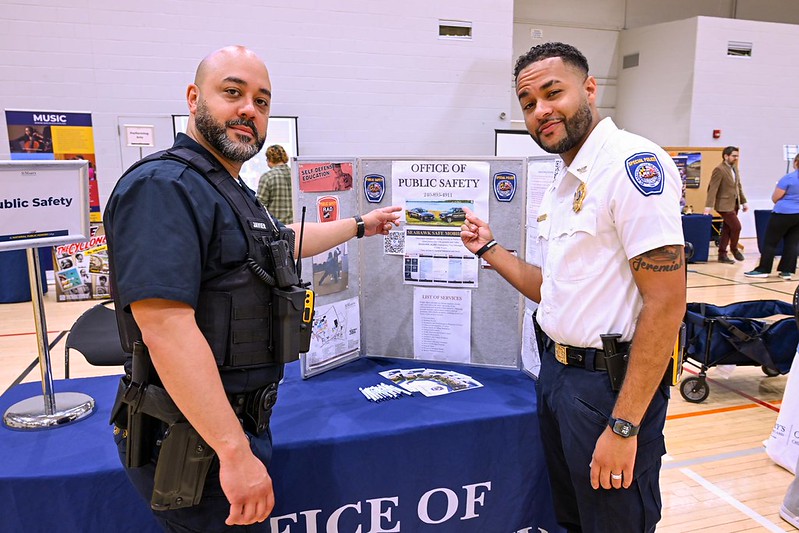
The Office of Public Safety is a full-time, 24-hour campus service, composed of sworn Special Police Officers, Public Safety Officers, and full or part-time Radio Dispatchers. Public Safety Officers respond to all calls for assistance and to reports of criminal incidents which may require first aid, investigation, and documentation. State and local police are available for specialized assistance when necessary and work closely with campus officers.
B. The Commissioned Public Safety officers employed by the college have arrest powers. They have been adequately trained by the Maryland Police Training Commission to respond to and evaluate all situations. Additionally, they work very closely with county and state police agencies in the area on matters of mutual concern.
III. Access and Security for College Facilities
A. All academic and administration buildings are checked and locked at the close of business and / or class each day. Students with a need to enter a locked building must do so by obtaining a valid building "pass" from a Faculty or Staff member. A Faculty or Staff member may also submit a list of students needing access to the office of Public Safety
B. All residence halls are equipped with card-access control of at least two entrances per building. The card-accessed halls are locked 24 hours a day 7 days a week, allowing entry to all current students from 7:00 a.m. until 12 midnight and, after midnight, only to hall occupants. Public Safety Officers make periodic security patrols within the halls on a 24-hour basis. The building access and emergency telephone systems are inspected and tested on a regular basis, and malfunctions are given priority for repair.
C. Residents are expected to comply with all residence hall and visiting policies: to use available security locks and not to prop locked doors open or to allow entrance to uninvited people. Each hall front office is staffed until midnight by trained and experienced student staff members. Information about security at individual halls is available through the Office of Residence Life.
D. All St. Mary's College students and employees are issued photo ID cards and are required to carry them while on campus.
IV. Crime Awareness and Prevention
A. New-student orientation programs address the issues of personal safety, crime prevention, fire safety, and emergency reporting procedures. A quick reference to Public Safety procedures and crime prevention tips can be found in the student handbook which is supplied to each student.
Residence Life Assistants (R.A.s) hold periodic, mandatory hall meetings where students receive crime prevention and fire safety instruction. At least once each semester, their meetings include appearances by Public Safety professionals and video presentations.
A daily incident desk log records all activity reported to Public Safety and is available to the media and the public.
B. The Office of Public Safety provides a night escort service to afford safer movement across campus for students, faculty, and staff. The service operates daily from Dusk until Dawn from any campus building to any on-campus location. Direct telephones to the Public Safety dispatcher are in various locations around campus.
C. Information directed to students and employees regarding crime prevention is disseminated by campus-wide memoranda, eye-catching awareness posters, a public adress system, and CCTV programming.
Public Safety Officers present periodic hall programs aimed at personal safety and property security awareness. Students are given the opportunity to register bicycles and engrave personal property.
Specialized crime prevention programs and panel discussions are publicized for presentation at the campus center and are open to both students and employees.
D. The St. Mary's College Office of Public Safety promptly reports to the campus community serious security and safety conditions which are considered to be a particular threat to students and employees.
The most serious conditions reported to the Office Public Safety or to local Police agencies are provided to the community in the form of printed notices and posters on display throughout the campus, a public adress system and the campus media services (CCTV and radio).
E. The St. Mary's College Office of Public Safety will assist students and staff in engraving and registering personal property to deter theft and to aid in the recovery of stolen property through the property registration program. This program is free of charge to the campus community.
V. Alcohol and Drug Policy
A. A drug and alcohol information guide has been prepared by the College and is distributed annually to each student and employee.
The guide outlines state law and college drug-free policy as well as penalties and sanctions for violations of laws and policy.
Alcoholic beverages are not sold on campus. However, possession and consumption is permitted in the rooms of students at least 21 years of age. Violations of this policy are addressed by the dean of student affairs and/or the campus Judicial Board.
Possession, sale, and use of illegal drugs is a violation of state law and College policy and will result in criminal arrest and prosecution. Violators are further subject to Judicial Board or administrative sanction.
B. Students are made aware and urged to seek confidential alcohol/drug evaluation, treatment, and referral through the campus counseling center.
Employees are urged to seek the above assistance through the State of Maryland employee Assistance Program.
Substance abuse education is available to students through a peer education program, periodically presented in residence halls and the student union.
The Student's Responsibility
The cooperation and involvement of students themselves in a campus safety program are absolutely necessary. Students must assume responsibility for their own personal safety and the security of their personal belongings by taking simple, common sense precautions. For example, although the campus is well-lighted, any student, male or female may feel more comfortable using the escort service when returning to the residence halls late at night. Room doors should be locked at night and when the room is unoccupied. Valuable items such as stereos, cameras, and televisions should be marked with engraving instruments provided by the College Office of Public Safety at no charge. Bicycles may be registered with College Office of Public Safety and should be secured with a sturdy lock. Students with cars must park them in their assigned lot and keep their vehicles locked at all times. Valuables should be locked in the trunk. Students should report any suspicious-looking individuals who they feel do not belong in their residence halls. They should also report any unusual incidents in and around the residence halls to the Residence Life staff or to Public Safety.
A voluntary confidential report provides an individual the opportunity to report a crime for statistical information to be included in the annual crime statistics report. College officials are also encouraged to refer individuals to report crimes on a voluntary confidential basis.
VI. Rape and Sexual Assault Policy
St. Mary's College is committed to maintaining an environment free from all exploitation and intimidation based on sex. The College will not tolerate rape or sexual assault or other forms of nonconsensual sexual activity. The College has taken a proactive stance against rape and sexual assault and has in place sexual assault protocols which are designed to address the health and safety of the victim, the emotional health of the victim, the common safety of the St. Mary's College community, the protection of the victim from undue embarrassment or publicity; these protocols also ensure confidentiality.
A number of programs designed to educate and promote awareness of sexual assault and related sexual offenses are in place at St. Mary's College. Presentations are given to all new students during orientation, and there is an ongoing program in the residence halls which addresses issues related to date rape and all degrees of sexual offenses. Additionally, booklets designed to promote prevention and awareness are placed throughout all residence halls and in other public areas.
The St. Mary's College Counseling Center provides support and assistance to victims of rape and sexual assault and conducts educational programs on campus in residence halls and at the counseling Center. In addition to campus resources, there are trained advocates available in the local community who will meet the survivor, and helps the individual sort out options and plans of action. Services and information are available at the College Health and Counseling Center, Ethel Chance Hall or by calling x4289.
Students should contact one of the following offices if they are the victim of a sex offense:
- 1. The Counseling Center can be contacted for assistance in notifying law enforcement agencies, including the Office of Public Safety, if the student chooses to do so.
- 2. A report can be filed with the Office of Public Safety. If Public Safety recieves a report of a sexual assault they must notify the St. Mary's County Sheriffs Office.
- 3. A complaint can be filed within the College Judicial system for disciplinary action against a St. Mary's College student assailant. This can be done along with criminal prosecution.
- 4. A report can be filed with the Maryland State Police or other local Law Enforcement Agency. Remember, in filing a criminal report it is important to preserve criminal evidence and obtain a rape physical examination at a hospital within 72 hours of the incident. At any time after a report is made it may be withdrawn from further action.
Procedures for on-campus disciplinary action in cases of sexual assault, and the possible sanctions to be imposed in such cases, including but not limited to the expulsion from the College, are available from the Office of Residence Life, x4207. In any disciplinary action the accuser and the accused are entitled to have an adviser present during a campus disciplinary procedure. Both the accuser and the accused shall be informed of the outcome of any campus disciplinary proceeding brought by alleging a sexual assault.
Students who are the victims of alleged sexual assault may change academic and living situations, if an alternative is reasonably available, by contacting Residence Life.
The federal Campus Sex Crimes Prevention Act requires institutions of higher education to issue a statement advising the campus community where information concerning registered sex offenders may be obtained. In Maryland, this information is accessible at the following Web site: www.dpscs.state.md.us/sor/
VII. SEARCHES
All Public Safety Officers adhere to the same laws and regulations as any other Law Enforcement Agency with regards to all searches of persons, residences, and / or vehicles.
The plain view doctrine allows an officer to seize without a warrant, evidence and contraband found in plain view during a lawful observation. In order for the officer to seize the item, the officer must have probable cause to believe the item is evidence of a crime or is contraband.
The plain view doctrine has also been expanded to include the sub doctrines of plain feel, plain smell, and plain hearing.
In Horton v. California 496 U.S. 128 (1990), the court eliminated the requirement that the discovery of evidence in plain view be inadvertent. Previously, "inadvertent discovery" was required leading to difficulties in defining "inadvertent discovery."
Officers do not need a search warrant, or even probable cause, to perform a limited search of a suspect's outer clothing for weapons, if police have a reasonable suspicion to justify the intrusion - a Terry 'stop and frisk.'
The Motor vehicle exception
Supreme Court has also held that individuals in automobiles have a reduced expectation of privacy, because vehicles generally do not serve as residences or repositories of personal effects. Vehicles may not be randomly stopped and searched; there must be probable cause or reasonable suspicion of criminal activity. Items in "plain view" may be seized; areas that could potentially hide weapons may also be searched. With probable cause, police officers may search any area in the vehicle. They may not, however, extend the search to the vehicle's passengers without probable cause to search those passengers.
VIII. Investigations
Public Safety Officers are responsible for all on-campus criminal and administrative investigations. Officers will if needed coordinate with the local law enforcement on investigations of crimes, felonies or otherwise, reported to the Office of Public Safety by members of the campus community. The officer monitors each crime referred to the local law enforcement through final disposition