|
Overview:
Faculty:
-
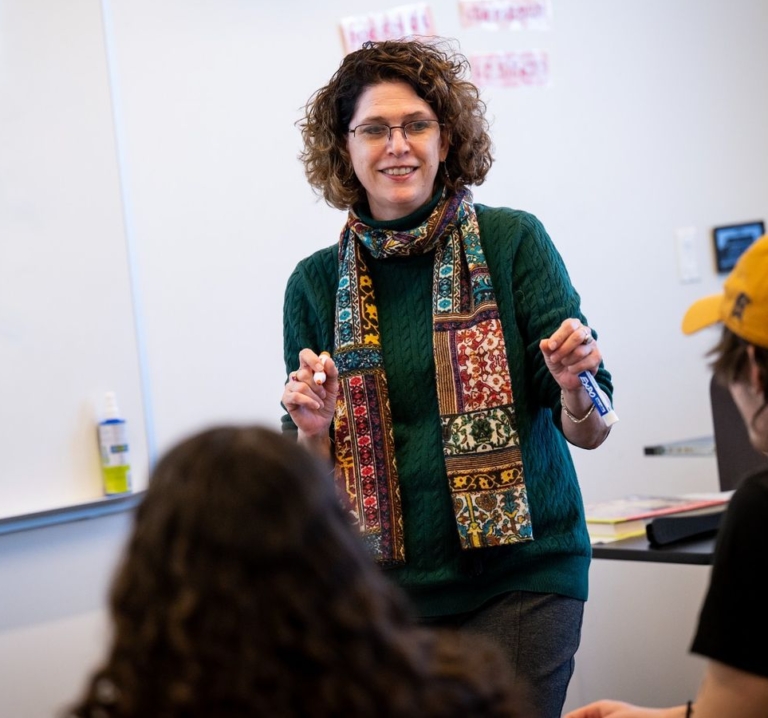
Anne Leblans,
Associate Professor of German (1987). "Kandidaat,"
U.F.S.I.A., Antwerp; "Licentiaat," U.I.A., Antwerp;
M.A., Ph.D., University of Oregon. Dr. Leblans grew up in the
Flemish speaking part of Belgium, where she finished her undergraduate
degree in Germanic Languages and Literatures (Dutch, German)
with a senior thesis on Walter Benjamin. She did her graduate
work in Comparative Literature (German, English, French and
some Spanish) at the University of Oregon. She is interested
in the carnivalesque and its subversive potential, in problems
of modernity and the dream-life of capitalism, in fairy tales
and children's books, and in psycho-historical aspects of reading.
She is a founding member and an active participant in the Women
Studies Program. In Germany, she has lived in Konstanz (1985-86)
and Berlin (1995-96).
e-mail
homepage back to top
-
Jacqueline M. Paskow,
Professor Emerita of Language and Literature (1981). B.A., Skidmore
College; M.A. Middlebury College; M.A., Ph.D., Yale University.
Dr. Jacqueline Merriam Paskow was born during World War II in
Fort Benning, Georgia and raised on army bases in the United
States and in England. She received a B.A. in French from Skidmore
College, after spending her junior year in France, and a Ph.D.
in French from Yale University, after teaching at a French lycée
on a student Fulbright grant. She later received an M. A. in
German from Middlebury College. She has taught at Deep Springs
College (California), Haverford College (Pennsylvania) and at
the University of Constance in Germany on a senior Fulbright
grant. She wrote her dissertation on the representation of suicide
in romanticist texts. Her abiding research interest are: 19th
and 20th century French and German-language and literature in
relationship to philosophy and social change; Italian; creative
nonfiction. On leave academic year 2005-2006.
e-mail
homepage back to top
Course
catalog: GERMAN COURSES
(ILCG)
-
ILCG 101. Elementary German
I (4F)
An introduction to the basic structures of spoken and written
German and an introduction to German culture and its relation
to the language. This course is for students beginning the study
of German.
-
ILCG 102. Elementary German
II (4S)
A continuation of the study of basic grammar. Increased attention
given to conversation and short creative writing assignments.
This course satisfies the general education requirement in foreign
language. Prerequisite: ILCG 101 or equivalent as determined
by the Foreign Language Proficiency Test.
-
ILCG 201. Intermediate German
(4F)
Review of grammar, development of conversational skills, weekly
writing assignments based on readings and class discussion.
Prerequisite: ILCG 102 or equivalent as determined by the Foreign
Language Proficiency Test.
-
ILCG 205. Intermediate Composition
and Conversation (4F)
Practice in German as a vehicle for communication. Speaking
and writing exercises will range from making simple requests
to articulating complex thoughts and emotions. Selected topics
and texts read in advance will provide a basis for class discussion.
Bi-weekly compositions assigned. Prerequisite: ILCG 201 or 206
or equivalent as determined by the Foreign Language Proficiency
Test.
-
ILCG 206. Introduction to
Literature in German (4S)
Students will study short literary texts representing several
periods and genres. Particular attention will be paid to the
social and historical context of the literature. Grammar will
be reviewed only as needed. Written assignments will be based
primarily on the readings. This course satisfies the general
education requirement in literature. Prerequisite: ILCG 201
or 205 or equivalent as determined by the Foreign Language Proficiency
Test.
-
ILCG 355. German Culture
and Civilization: History and Everyday Life in the 20th Century
(4AF)
This course deals with problematic aspects of Germany's recent
past. The emphasis is on an exploration of issues through the
study of a variety of sources: documentary and feature films,
eye-witness accounts, diaries, art work and literary texts,
newspaper and magazine articles, essays, cultural criticism,
etc. Examples of courses that have been offered under this heading
are Aspekte der Weimarer Republik, and Geschichte
and Alltag im 20ten Jahrhundert. The
topic of this course, which is often taught as a workshop, is
different whenever the course is offered. May be repeated
for credit. Pre- or co-requisites: ILCG 205 or 206 or consent
of the instructor.
-
ILCG 356. German Culture
and Civilization: Historical (4AF)
The topic of this course is often a response to contemporary
issues of great urgency and complexity in a rapidly changing
Germany (the collapse of communism and the fall of the Wall,
reunification and the psycho-social problems that accompanied
it, the decline of the nation state and the European identity
crisis, migration, shifting boundaries, etc.). The course studies
how these issues developed historically, often going back as
far as the Middle Ages. Examples of courses that have been offered
under this heading are Hauptstadt Berlin, Fremdgruppen
in Deutschland, and Das Deutsche Neunzehnte Jahrhundert.
The topic of this course is
different whenever it is offered. May be repeated for credit.
Pre- or co-requisites: ILCG 205 and 206 or consent of the instructor.
-
ILCG 360. Advanced Grammar
and Translation (4AS)
Study of grammatical and stylistic structures as they apply
to the task of translating a variety of texts from German into
English and from English into German. Pre- or co-requisites:
ILCG 205 and 206 or consent of the instructor.
-
ILCG 362. Topics in German
Literature I (4AS)
Close study of selected major literary works from the Middle
Ages to the Age of the Enlightenment. The course will normally
focus on a theme, movement, or genre which links the selected
works in a common or conflicting tradition. Class discussion
and short papers will aim at developing the ability to read
literature critically. A short creative writing project is part
of the requirements. Although the course focuses on a pre-modern
period, links are made to later periods and to the present.
Recent offerings: the Middle Ages and how medieval imagery and
ideas were revitalized by the Romantics and the 20th century;
and "Der Garten," what historical changes this archetypical
image underwent in different periods from the Middle Ages to
the twentieth century. The
topic of this course is different whenever it is offered. May
be repeated for credit. Pre- or co-requisites: ILCG 205
and 206 or consent of the instructor.
-
ILCG 363. Topics in German
Literature II (4AS)
Close study of major literary works from the period of Romanticism
to the present. The selection of works will normally reflect
a particular theme, movement, or genre which links the selected
works in a common or conflicting tradition. Class discussion
and short papers will aim at developing the ability to read
literature critically. The
topic of this course is different whenever it is offered. May
be repeated for credit. Pre- or co-requisites: ILCG 205
and 206 or consent of the instructor.
-
ILCG 493/494. St. Mary's
Project (8E)
A student-initiated and student-executed project of eight semester-hours
is the senior capstone experience, to be carried out in the
language of study (with the exception of Chinese). The project
may be a research project in literary or cultural studies, a
creative-expressive project involving the arts, or a pedagogical
project involving teaching applications. Also, depending on
the focus of the student's course work and interests, the project
can be single or multi-disciplinary based. Whatever the nature
of the project, students must demonstrate in it: 1) linguistic
competence equal to the task, 2) a method of approach and execution
appropriate to the task, 3) adequate knowledge of the particular
area of research or endeavor, 4) an ability to analyze and reflect
upon this knowledge in order to integrate it with knowledge
in other areas of inquiry or performance, and 5) the readiness
to critically discuss and publicly share the results of the
project. Prerequisites: ILCT 393; approval of a faculty project
mentor; approval of the department chair of the student's major(s).
NOTE: Students whose projects are to be based on material collected
"in the field" while studying abroad during their
junior year or while engaged in off-campus apprenticeships or
internships should discuss their plans with a faculty adviser
as early as the second semester of their sophomore year. This
course is repeatable for up to a total of eight semester-hours.
-
ILCG 199, 299, 399, 499.
Independent Study (1-4E)
This course consists of an independent creative or research
project designed by the student and supervised by a foreign
language faculty member. The nature of the project, the schedule
for accomplishment, and the means of evaluation must be formalized
in a learning contract prior to registration. (See "Independent
Study" under "Academic Policies" section.)
- ILCT 302. German Studies in
Translation (4AF)
The study of major works in the German-speaking literary traditions
of Europe, or the study of basic philosophical, moral, social,
and political dilemmas of German-speaking societies. May be repeated
for credit.
back to top
Study
abroad:
For students of German, the department
offers a short study abroad program to Berlin
(see Dr. Anne Leblans).
For a year-long study abroad experience,
St. Mary's has an exchange program with the University of Heidelberg
in Heidelberg, Germany (see Drs. Anne
Leblans or Jacqueline Paskow).
For these programs you pay St. Mary's College tuition and credit
is granted by St. Mary's College in the form of a grade.
For more details concerning study abroad
options, click here.
back to top
|