The Public Honors College
St. Mary's College of Maryland

ST MARY'S COLLEGE OF MARYLAND

ANNUAL CRIME AND FIRE SAFETY REPORT

bar

January 1, 2008 through December 31, 2008

 
The following information is provided to better inform campus students and others.  The information conforms to the requirements of the "Jeanne Clery Disclosure of Campus Security Policy and Campus Crime Statistics Act".


CAMPUS LAW ENFORCEMENT

St. Mary's College of Maryland employs a staff of full-time professional commissioned and non-commissioned public safety officers. Campus public safety officers are unarmed however; commissioned officers have the full powers of reasonable search, seizure, and arrest. Campus public safety may defer any criminal investigation or situation, which may involve an arrest to the local law enforcement authorities. The dean of students administers student disciplinary matters.

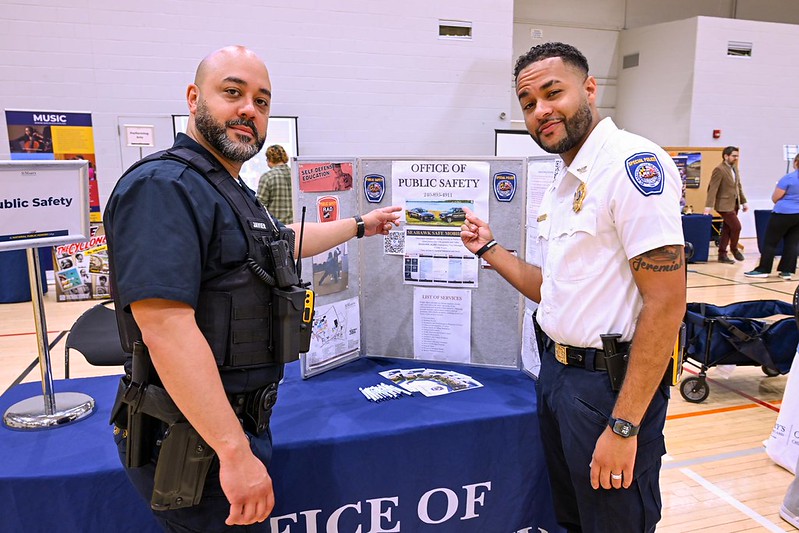
The Office of Public Safety is operational twenty-four hours a day, seven days a week. In the event of criminal or suspicious activity or person, the public safety office should be contacted at the following numbers:

If emergency police service is required, 9-911 should be called, prior to notifying the Office of Public Safety.

Office of Public Safety: 4911 or (240) 895-4911 (answered 24 hours per day).


ACCESS AND SECURITY FOR COLLEGE FACILITIES

All campus residence halls are locked twenty-four hours a day. Resident directors and resident assistants are available to provide assistance. Visitors may gain access by contacting the student they are visiting. Exterior doors are not to be propped opened and left unattended, under any circumstances. Additional policies are contained in the Student Handbook, and are administered by the dean of students.

Academic buildings are secured each evening by campus Public Safety Officers. The schedule of closings varies based on each building, normal hours of operation and scheduled activities. Students or visitors are not permitted in buildings after hours without prior approval. Public Safety Officers will escort any unauthorized person from the building. Criminal trespass could result in arrest.


CRIME AWARENESS, TRAINING, AND PREVENTION

The Office of Public Safety's success depends on the support and assistance of the campus community. Any suspicious persons, behavior, or activity must be reported promptly.

Students, faculty, and staff must ensure their safety and the safety of their property by practicing fundamental crime prevention techniques. To that end, public safety will provide orientation sessions at the beginning of the fall semester for students. These sessions will typically be held in conjunction with residence hall orientations. In addition, safety and crime prevention information will be published, periodically, in available campus publications.  Public Safety will accommodate scheduling any request for training or additional information.

Programs designed to educate and promote awareness of sexual assault and related sexual offenses are in place at St. Mary's College through the Sexual Assault Response and Prevention (SARP) Program. Presentations are given to all new students during New-Student Orientation, and there are programs in the residence halls, which address issues related to date rape and all degrees of sexual offenses. In class presentations, discussions and campus-wide awareness events also take place throughout the school year. Additionally, booklets and posters designed to promote prevention and awareness are placed throughout all residence halls and in other public areas.


ALCOHOL AND DRUG POLICY

The Alcohol and Drug Abuse Policy is published in the Student Handbook, Employee Handbook, and Memorandum of Understanding.


RAPE AND SEXUAL ASSAULT

St. Mary's College is committed to maintaining an environment free from all exploitation and intimidation based on sex. The College will not tolerate rape or sexual assault or other forms of unwanted sexual activity. The College has taken a proactive stance against rape and sexual assault and has in place sexual assault protocols, which are designed to address the health and safety of the victim, the emotional health of the victim, the common safety of the St. Mary's College community, and the protection of the victim from undue embarrassment or publicity. These protocols also ensure confidentiality.

The St. Mary's College SARP Program runs out of the Counseling Center and provides support and assistance to victims of rape and sexual assault and conducts educational programs on campus in residence halls and at the counseling center. In addition to campus resources, trained advocates are available in the local community who will meet the survivor and help him/her sort out options and plans of action. Services and information are available at the College Health and Counseling Center, Ethel Chance Hall, or by calling ext. 4289.

Students should contact one of the following offices if they are the victims of a sex offense:

1.    The SARP Coordinator serves as a single point of contact to organize sexual assault victim care and can be reached from 10 a.m. to 5 p.m. weekdays (x4289). In addition to providing support, the SARP Coordinator can make referrals to all necessary resources, including campus Counseling Services, Walden Sierra, Inc. Sexual Assault Legal Institute (SALI), etc.

2.    A report can be filed with Public Safety (ext. 4911). If Public Safety receives a report of a sexual assault they must notify the St. Mary's County Sheriffs Office.

3.    A complaint can be filed within the College judicial system (ext. 4208) for disciplinary action against a St. Mary's College student assailant. This can be done along with criminal prosecution or instead of it.

4.    A report can be filed with the Maryland State Police or other local law enforcement agency. Remember, in filing a criminal report, it is important to preserve criminal evidence and obtain a rape physical examination at a hospital within 72 hours of the incident. At any time after a report is made it may be withdrawn from further action.

5.    The Walden Sierra 24-hour Crisis Hotline (301-863-6661) can be contacted day or night.

Procedures for on-campus disciplinary action in cases of sexual assault, and the possible sanctions to be imposed in such cases, including but not limited to the expulsion from the College, are available from the Judicial Affairs Coordinator, ext. 3181. In any disciplinary action the accuser and the accused are entitled to have an adviser present during a campus disciplinary procedure. Both the accuser and the accused shall be informed of the outcome of any campus disciplinary proceeding brought by alleging a sexual assault.

Additional safety and crime prevention information will be published, periodically in available campus publications. Public Safety will accommodate scheduling any request for training or additional information

To help students understand behaviors that constitute sexual assault, we have provided the following definitions adopted by St. Mary's College of Maryland. These definitions are provided in addition to sexual offenses as defined by Maryland Annotated Code.

Sexual Assault I: By stranger or acquaintance, rape, forcible sodomy, or forcible sexual penetration, however slight, of another person's anal, genital, or oral opening with any object. These acts must be committed without consent and/or force, threat, intimidation or through the use of the victim's mental or physical incapacitation (e.g. due to excessive use of alcohol or drugs or a mental or physical health condition) of which the accused was aware or should have been aware.

Sexual Assault II: By stranger or acquaintance, the touch of an unwilling person's intimate parts (defined as genitalia, groin, breast, or buttocks, or clothing covering them) or forcing an unwilling person to touch another's intimate parts. These acts must be committed without consent and/or by force, aggression, threat, intimidation or through the use of the victim's mental or physical incapacitation (e.g. due to excessive use of alcohol or drugs or a mental or physical health condition) of which the accused was aware or should have been aware.

Consent: Consent is defined as the act of willingly and verbally agreeing to engage in sexual conduct. Consensual sex is a mutual decision reached by both parties without any hint of force or coercion.

Because of the sensitive nature of these charges, it is in the best interest of all parties involved in a hearing to have no contact with one another prior to and after a hearing. In addition, verbal, physical, or mental harassment, and intimidation of any member of the judicial body including complainants, respondents and any witnesses prior to, during, or after a judicial proceeding is a violation of college policy and will result in additional judicial proceedings.

Students who are the victims of alleged sexual assault may change academic and living situations, if an alternative is reasonably available, by contacting Residence Life at ext. 4207.

The federal Campus Sex Crimes Prevention Act requires institutions of higher education to issue a statement advising the campus community where information concerning registered sex offenders may be obtained. In Maryland, this information is accessible at the following Web site: www.dpscs.state.md.us/sor/.


MISSING PERSONS

Each student has the option to identify an individual to be contacted by the college no later than 24 hours after the time that the student is determined to be missing.

The individual identified will be the same person listed as the official emergency contact as noted on the Housing Contract (for resident students) or as noted on the Admissions application (for commuting students).The contact information is considered confidential.

The College is required to notify a custodial parent or guardian no later than 24 hours after a student is determined to be missing if the student is under the age of 18 and not yet emancipated.

Any and all reports of a missing person will be directed to Public Safety.

The College will notify the appropriate law enforcement agency no later than 24 hours after the time that the student is determined to be missing.

Once notified of a possible missing person, Public Safety officials, in collaboration with Residence Life and other departments as needed, will determine whether or not a student is considered missing.

Residence Life professional staff or Public Safety staff will initiate the emergency contact procedures.

Once it is determined that a student is missing for at least 24 hours, notification will be made to the student's: RA and RHC by the Office of Residence Life; Counseling and Health Services by the Office of Residence Life; and professors by the Office of Academic Services. In addition, the Office of the Dean of Students and the Provost's Office will also be notified by the Office of Residence Life.

If and when the student returns to campus, those noted above (including the emergency contact) will be notified.

All students are strongly urged to do the following:

  • Let friends, roommates, or family know where you are going, when you expect to return, and who you will be with.
  • If your plans change, let your friends, roommates, or family know of the changes.
  • Be cautious when accepting drinks, rides, etc. from people you do not know or do not know well.
  • Keep your cell phone charged and with you whenever you are away from campus.
  • Try to stay in groups or with at least one other trusted friend when at- tending parties, going off-campus, etc.
  • Do not leave friends in unfamiliar locations, situations, etc.

EMERGENCY RESPONSE

Health and safety at St. Mary's College of Maryland is a critical component of our organizational policies.  We take the well being of our campus community and visitors very serious. An Emergency Response Team (ERT) has been established and is activated in the event of serious incident or an emergency on campus.  Our procedures are designed to provide information that will aid in an effective response to various emergencies and can be viewed at http://www.smcm.edu/emergency.  The college also has two mass communication early warning system towers on the roof its campus center, Charles Hall and the athletics and recreation center (ARC) which provides mass communication in the event of an emergency or crisis situation.  The system is tested on an annual basis, usually at the beginning of the fall semester.


CRIME STATISTICS

As required, the following statistics are provided for the preceding three-year period. Stats from previous years are on file at the Public Safety Office. The following offenses are reported:

Arson: The willful or malicious burning or attempt to burn (w/o the intent to defraud) a dwelling, house, public building, motor vehicle or aircraft, or personal property of another. (Includes attempts)

Aggravated Assault: An unlawful assault upon the person of another for the purpose of inflicting severe or aggravated bodily injury. (Includes attempts, and whether or not an injury occurred.)

Burglary: The unlawful entry (or attempts to enter) into a defined structure with the intent to commit a theft or any felony. (Excludes vehicle burglary)

Homicide: Murder (The willful (non-negligent) killing of a human being by another), Manslaughter (The killing of another person through gross negligence).

Sex Offense (Forcible): Any sexual act directed against another person without the other person's consent. (Includes attempts), Sexual intercourse (penetration-however slight), Sodomy (penetration-however slight), Oral copulation (vaginal, anal), Rape with a foreign object (penetration vaginal or anal-however slight), Sexual battery (the touching of the intimate parts [sexual organ, anus, groin, or buttocks of any person, or the breast of a female] of another person for the purpose of sexual gratification.)

Sex Offense (Non-forcible): Any unlawful, but consensual sex act with another person. (Includes attempts), Incest (sexual intercourse between persons who are related to one another within the degrees wherein marriage is prohibited), Statutory rape (intercourse with a person who is under the age of consent-18 years)

Robbery: The taking of personal property in the possession of another, from his/her immediate presence, and against his/her will, accomplished by means of force or fear. (Includes attempts)

Motor Vehicle Theft: The taking of a motor vehicle (as defined) without the consent of the owner with the intent to either permanently or temporarily deprive the owner of the vehicle. (Includes attempts)

Alcohol Violations: The violation of state and local laws or ordinances prohibiting the manufacture, sale, purchase, transportation, possession, or use of alcoholic beverages, not including driving under the influence and drunkenness.

Drug/Narcotic Violations: The manufacture, distribution, sale, purchase, use, possession, transportation or importation of any controlled drug or narcotic substance.

Weapons Violation: The unlawful possession or control of any firearm, deadly weapon, (including nunchakus or billy club) illegal knife or explosive device.

Hate Crimes: A criminal act involving one or more of the listed crimes, the crimes of Theft, Simple Assault, Intimidation and Vandalism, and any other crime involving bodily injury which was motivated by bias against any person or group of persons, or the property of any person or group of persons because of the ethnicity, race, national origin, religion, gender, sexual orientation, or disability of the person or group, or bias based upon the perception that the person or group has one or more of those characteristics.


As required, offenses are separated by location:

ON: St. Mary's College of Maryland campus property either controlled or owned within the same reasonably contiguous area, and used by the institution in direct support of, or related to, its educational purpose including all buildings and grounds.

NON: Building or property in use or controlled by the College which is not on the campus.  Currently, the College has no off-campus student housing or facilities housing off-campus student organizations.

PUBLIC: Public property immediately adjacent to the College

RES: On campus residence halls including all dorms and townhouses.  Res stats are already counted in the on campus stats.

Statistics are compiled using campus incident reports, and information received from the local law enforcement authorities.


Crime Statistics for 2008


ON

NON

PUBLIC

TOTAL

RES

ARSON

0

0

0

0

0

AGGRAVATED

ASSAULT

1

0

0

1

0

BURGLARY

5

0

1

6

5

HOMICIDE

0

0

0

0

0

SEX OFFENSE

FORCIBLE

0

0

0

0

0

SEX OFFENSE

NON-FORCIBLE

0

0

0

0

0

ROBBERY

0

0

0

0

0

MOTOR VEHICLE THEFT

0

0

0

0

0

ALCOHOL ARRESTS

0

0

0

0

0

ALCOHOL REFERRALS

122

0

0

122

86

DRUG ARRESTS

2

0

0

2

0

DRUG REFERRALS

90

0

0

90

46

WEAPON ARRESTS

0

0

0

0

0

WEAPON REFERRALS

0

0

0

0

0

None of the above were classified as hate crimes

(0 hate crimes/incidents were reported but not in the above categories)

Crime Statistics for 2007


ON

NON

PUBLIC

TOTAL

RES

ARSON

0

0

0

0

0

AGGRAVATED

ASSAULT

1

0

0

1

0

BURGLARY

5

0

0

5

3

HOMICIDE

0

0

0

0

0

SEX OFFENSE

FORCIBLE

2

0

0

2

1

SEX OFFENSE

NON-FORCIBLE

0

0

0

0

0

ROBBERY

0

0

0

0

0

MOTOR VEHICLE THEFT

2

0

0

2

0

ALCOHOL ARRESTS

0

0

0

0

0

ALCOHOL REFERRALS

179

0

0

179

0

DRUG ARRESTS

0

0

0

0

0

DRUG REFERRALS

46

0

0

46

0

WEAPON ARRESTS

0

0

0

0

0

WEAPON REFERRALS

0

0

0

0

0

None of the above were classified as hate crimes

(0 hate crimes/incidents were reported but not in the above categories)


Crime Statistics for 2006


ON

NON

PUBLIC

TOTAL

RES

ARSON

0

0

0

0

0

AGGRAVATED

ASSAULT

1

0

0

1

0

BURGLARY

6

0

0

6

6

HOMICIDE

0

0

0

0

0

SEX OFFENSE

FORCIBLE

0

0

0

0

0

SEX OFFENSE

NON-FORCIBLE

0

0

0

0

0

ROBBERY

1

0

0

1

1

MOTOR VEHICLE THEFT

0

0

0

0

0

ALCOHOL ARRESTS

2

0

0

2

2

ALCOHOL REFERRALS

186

0

0

186

0

DRUG ARRESTS

0

0

0

0

0

DRUG REFERRALS

42

0

0

42

0

WEAPON ARRESTS

0

0

0

0

0

WEAPON REFERRALS

0

0

0

0

0

None of the above were classified as hate crimes

(0 hate crimes/incidents were reported but not in the above categories)


FIRE SAFETY

The purpose of this report is to provide fire safety statistics and information in accordance with the Higher Education Act Reauthorization of 2008.


Traditional Residence Halls:

The on-campus student housing facility fire safety system, including the fire sprinkler system in the traditional residence halls (Calvert, Caroline, Dorchester, Prince George, and Queen Anne), the fire safety system includes:

  • Smoke detectors in each bedroom and study lounge.
  • Fire alarm pull-stations, bells, horns, and/or strobe lights (when needed for hearing impaired students) in all common areas.
  • Heat sensors in corridors, recreation rooms, kitchens.
  • Emergency lights in corridors.
  • Fire extinguishers in each corridor, kitchen, laundry room, and each apartment.
  • Standing water valves in each corridor, accessible by Physical Plant and Public Safety staff as well as the local fire departments.
  • Fire hydrants in proximity to the residences.
  • Notification to all local fire departments of disabled students and where they live.

Non-Traditional Residence Halls:

The on-campus student housing facility fire safety system, including the fire sprinkler system in the non-traditional areas residence halls (Lewis Quad, Townhouse Complex, Waring Commons), the fire safety system includes:

  • Smoke detectors in each bedroom and study lounge.
  • Fire alarm pull-stations, bells, horns, and/or strobe lights (when needed for hearing impaired students) in all common areas in Lewis Quad.
  • Fire alarm bells, horns, and/or strobe lights (when needed for hearing-impaired students) in all common areas in the Townhouse Complex and Waring Commons.
  • Emergency lights in stairwells in Lewis Quad and Waring Commons.
  • Fire sprinkler systems.
  • Fire hydrants in proximity to the residences.
  • Fire extinguishers in each laundry room, common area stairwell (Waring Commons), suite (Lewis Quad), or kitchen area (Townhouses).
  • Notification to all local fire departments of disabled students and where they live.

Regular, mandatory, supervised fire drills:

Calvert, Caroline, Dorchester, Lewis Quad, Prince George, and Queen Anne are required to have at least one regular, mandatory, supervised fire drill each September.

The Townhouses and Waring Commons do not have supervised fire drills, as we do not have a way of setting off the alarm in a systematic manner.

Fire Safety Policies, are noted on the Residence Life Web page, in the Student Handbook, and/or the Housing Contract, Resident Student Guide (www.smcm.edu/residencelife) and includes the following:


Antenna, Electrical Wiring, Fire Safety, and Appliances

Residents are not permitted to install outdoor antennas or other devices on the exterior of any residence hall, suite, apartment, or townhouse or in adjacent trees or shrubbery. Under no circumstances may the electrical wiring in a room be altered. Installation or alteration of electrical equipment is prohibited. Fires in student rooms have resulted from electrical defects or careless use of electrical appliances. The following are the ONLY appliances which may be operated in student rooms: answering machine, clock, computer and printer, curling iron, electric blanket (with heat control), electric curlers, fan, hair dryer, hot pot (must have closed heating element), iron, lamp (except halogen*), popcorn popper, refrigerator (less than 5 cubic feet capacity, only one per room), radio, sewing machine, shaver, stereo equipment, television, typewriter, VCR.

Students living in the suites, apartments, or townhouses are permitted to have one microwave oven per suite, apartment, or townhouse unit.  Students in traditional residence halls are not permitted to have a microwave in their rooms.  One is provided in the common area kitchen.

Electrical appliances not included on this list are not allowed and may be confiscated and stored at the student's expense. No appliances may have an exposed heating element. All appliances must be UL-approved. Candles and incense are not permitted due to the danger of open flame and unattended heat sources. Window air conditioners are permitted only for those students with approved medical reasons who have received written permission from the Health

Center and the Associate Dean of Students.

Halogen lamps have been responsible for a number of housing fires across the country. Halogen bulbs burn three times as hot as incandescent bulbs. They are not permitted at SMCM.


Health and Safety (H&S) Inspections

Residence Life staff will conduct health and safety inspections when we close for Thanksgiving Break (November), Winter Break (December), and Spring Break (March).  We will focus on fire safety concerns, health & safety issues, cleanliness issues, and use these inspections in an effort to reduce end-of-the-year damage billing.  If we nip potential problems earlier than May, it will help with the transition from academic year to summer-housing use, thus reducing the amount of time we spend on room inspections and damage billing.

Staff members will post notification flyers at least three days prior to each H&S inspection. Staff will write in the specific date and time of the inspection (residents do not need to be present).  Staff will do a visual inspection of the room and will not open drawers or closets. Staff will be checking for:

  • General cleanliness (especially apartments and townhouses kitchens and bathrooms)
  • Disabled smoke detectors
  • Overloaded electrical outlets
  • Tapestries blocking lights, smoke detectors, doors, windows
  • Excessive trash
  • Evidence of pets, smoking, candles, incense
  • Unauthorized appliances or lofts
  • General cleanliness of the area
  • Obvious damage to College property
  • Belongings improperly stored in HVAC closets (Townhouses only)
  • Condition of the carpet (Townhouses only)
  • Properly charged fire extinguishers (Apartments and Townhouses only)

RAs will note issues and concerns initially, share this information with residents, give the residents two to three days to correct the problems and then re-inspect. While residents may not make repairs to holes, etc., they must remove all other problems cited, such as tapestries, microwave, pets, etc. If the corrections are not completed, the RA will submit an incident report for follow-up.

The inspections will take place as follows:

The Tuesday before Thanksgiving (Thanksgiving Closing)

The Friday after fall semester final exams end (Winter Break Closing)

The Friday we close for Spring Break (Spring Break Closing)


Holiday Decorations

Students may decorate their rooms and hallways for holidays.

  • All decorations must be UL-approved and marked "flame resistant" or "flame retardant."
  • Live trees and greenery, and decorations containing crepe paper or pyroxylin plastics may not be used.
  • Nothing should be attached to or touch the ceilings or floors, especially in the hallways (exception: decorations with a stand securely placed on the floor).
  • Open flames are not permitted.
  • Twinkle lights may be strung along the walls.
  • One extension cord per outlet is permitted, with only one device plugged into the cord (that is, the cord is NOT there to provide additional outlets) and is only temporary, not stretched across doors, floors, under rugs, etc.
  • Nothing should block a light fixture or smoke detector at any time.
  • Students are not permitted to decorate exit doors, door handles, electrical equipment (including lights, panels, and switches), fire protection equipment (including alarms, extinguishers, lights, panels, or smoke detectors), stairs, stairwells, and windows.

Decorations, Tapestries

Due to fire safety regulations, students are not permitted to block light fixtures or smoke detectors with tapestries or other material. Because windows and doors must be accessible in the event of a fire, students may not hang material in a manner so as to block easy access to these egress points.


Smoking Policy

St. Mary's College of Maryland establishes the following policy regarding the smoking and use of tobacco products.  The Governor's Executive Order (01.01.1992.20) establishes guidelines upon which the St. Mary's policy is based.

Policy

Buildings: Smoking or carrying any lighted tobacco product is prohibited in all state buildings and facilities.

Residence Halls, Suites, Apartments, and Townhouses: Smoking is prohibited in all areas of all residential facilities.

State Vehicles: State employees are prohibited from smoking in state vehicles.


Enforcement

Responsibility: All employees and students share in the responsibility for adhering to and enforcing this policy and have the responsibility for bringing it to the attention of visitors.

Conflict resolution: The Office of Human Resources is responsible for resolving conflicts and investigating claims of employees. The judicial affairs adviser is responsible for resolving conflicts and investigating claims of students.


Disciplinary procedures:

For an employee found in noncompliance, the following shall result:

  • For the first offense: be directed to Human Resources for counseling on the provisions of the Executive Order (verbal warning).
  • For the second offense: be given a written reprimand.
  • For a third offense: receive a suspension.
  • For a fourth or subsequent offense: may result in termination of employment.

For a student found in noncompliance, the following shall result:

  • For the first two offenses: a verbal warning will be issued each time.
  • For a third offense: an incident report will be forwarded to the Coordinator of Judicial Affairs for adjudication.

Housing Contract:

Use of Premises: Residents may not use or permit the use of their rooms, the buildings, or any residential facility for any illegal or commercial purposes.  The sale of goods and services is not allowed in the residences unless a permit is obtained in advance from the Office of Residence Life.  Structural modification to student rooms is not permitted.  Only College-provided lofts are permitted in the buildings. Cooking is not permitted in student rooms with the exception of the kitchens in the townhouses and apartments. The unauthorized use of or tampering with emergency or fire equipment or any other College property is subject to immediate suspension from assigned housing, revocation of this contract and all housing privileges, judicial action, and civil and criminal action.


Procedures for evacuation:

Residence Halls and Suites: Each residence hall is equipped with smoke detectors, a fire alarm or bell, and firewalls. Lewis Quad and Waring Commons suites also have sprinkler systems. Residence halls have water fire extinguishers on the residential floors for small, containable fires. Multi-purpose extinguishers (ABC) are located in the kitchen, front office, and laundry room. If the building's fire alarm is sounding or if there is a fire, the building should be evacuated immediately. Call 9-911, notify Public Safety at ext. 4911, and then notify an RA or the residence hall coordinator.

Waring Commons Apartments and Townhouses: Each apartment and townhouse is equipped with smoke detectors, a fire alarm or bell, a sprinkler system, and firewalls. Apartments and townhouses also have a fire extinguisher for small, containable fires. If there is a fire in an apartment or townhouse, students should evacuate immediately, call 9-911, notify Public Safety at ext. 4911, and then notify an RA or the RHC.

For All Residents: When the alarm rings, you may not know whether it is a drill or a real fire. Always assume there is a real fire and evacuate quickly. Please keep in mind that during a real fire, equipment from three or four companies will be responding to these areas. Do not assemble on or near a road or fire hydrant.

Evacuation Points: Students should gather in the designated location as follows:

Calvert Hall: Students should move toward the front steps of St. Mary's Hall. In the event of bad weather or an extended evacuation, students will be permitted to enter St. Mary's Hall.

Caroline, Dorchester, and Prince George: Students should move to the Montgomery Hall patio area located at the main entrance of the building. In the event of bad weather or extended evacuation, students will be permitted to enter Montgomery Hall.

Lewis Quadrangle: Students should move toward the grass areas around DPC. In the event of bad weather or an extended evacuation, students will be permitted to enter DPC.

Queen Anne Hall: Students should move toward the wooded area behind the dumpster located in the front of the building (parking lot). In the event of bad weather or an extended evacuation, students will be permitted to enter Montgomery Hall.

Townhouses - Harrington, Boone, Homer Dodge, Maggie Dodge, Morsell, and Trueschler: Students should exit toward the Townhouse Green and then proceed to the patio area of DPC. In the event of bad weather or an extended evacuation, students will be permitted to enter DPC.

Townhouses - Southern Crescent and Northern Crescent: Students should move toward the grass areas around DPC. In the event of bad weather or an extended evacuation, students will be permitted to enter DPC.

Waring Commons: Students should move toward Lewis Quad. In the event of bad weather or an extended evacuation, students will be permitted to enter the LQ rec. room and DPC. Students should not block the roadway.


False Alarms

Several colleges and universities have recently experienced problems with false fire alarms that have resulted in tragedy: students became desensitized to fire alarms and remained in their rooms instead of evacuating the building because they thought it was "just another false alarm." Unfortunately, in a few cases (for example, Seton Hall University), students died in residence hall fires.  Students who pull false alarms endanger everyone's safety. Fire alarms should only be activated in the event of an actual fire. On-campus judicial action as well as civil action through the local court system may be initiated for pulling false alarms.


Fire Extinguishers

If using a fire extinguisher, remember to pull the safety pin and aim the hose nozzle at the base of the fire.

If you have reason to use the fire extinguisher in your room, etc., you are required to notify Public Safety. Do not assume that a fire, however small, is out. Leave this to a Public Safety officer or the Fire Department. Remember, the fire extinguisher will need to be recharged after ANY discharge, partial or full. Students should refrain from discharging a fire extinguisher unless putting out an actual fire.

Sprinkler Heads, Smoke Detectors, and Fire Alarms

Students are not permitted to hang anything from a sprinkler head, smoke detector, or alarm/strobe light box. Additionally, items (for example, tapestries) may not cover or block a sprinkler head, smoke detector, or alarm/strobe light box. These items are routinely checked during Health and Safety inspections. Violation of these mandates, when noticed during an inspection or by College employees (Residence Life, Maintenance, etc.), must be corrected immediately by the residents. If the residents are unavailable, the appropriate corrective action may be initiated to assure life safety and property protection. Please do not hang items on or from the ceiling.

In addition to the safety equipment discussed above, every block (Harrington, Boone, etc.) or section (Southern Crescent 1-14, Northern Crescent 1-26) of townhouses is equipped with a bell-warning system in case a fire becomes uncontrollable. In the event this happens, students throughout the complex should evacuate their townhouses immediately and notify Public Safety and the Residence Life staff.

Fire safety education and training policy provided to students, faculty, and staff:

  • Residence Life staff receive at least two hours of fire safety training each August.
  • They receive information on fire safety procedures, fire prevention, Health and Safety Inspections, and new staff learn how to use a fire extinguisher. In addition, all staff are trained on their building evacuation system.
  • Resident students are trained before classes begin on evacuation procedures, fire safety, Health and Safety inspections.
  • Prior to each break (Thanksgiving, Winter, Spring), Residence Life staff have hall meetings with their residents to review Health and Safety Inspection information.
  • Faculty and staff are periodically reminded via e-mail to refrain from using open flames (candles) in offices, refrain from overloading outlets, to turn off lights, etc.

Plans for future improvements in fire safety:

  • The implementation of a more detailed fire safety training program for faculty and staff

Statistics for each on-campus student housing facility to include:

  • The number of fires and the cause of each fire
  • The number of injuries related to a fire that result in treatment at a medical facility
  • The number of deaths related to a fire
  • The value of the property damage caused by a fire

Definitions:

False Alarm: The fire alarm system was intentionally activated when no fire or danger existed.

Unwanted Alarm: The fire alarm system was activated as it was designed to do, though the ultimate cause of the alarm was unwanted and/or not malicious, for example, dust entering a smoke detector, burned popcorn, etc.


Student Residences Summary:

Year

2006

2007

2008

Total Alarms/Year

34

21

27

Fires

10

3

2

  • Damages


$0

$55

  • Injuries

0

0

0

  • Fatalities

0

0

0

False Alarms

5

3

6

  • Damages


$55

$0

  • Injuries

0

0

0

  • Fatalities

0

0

0

Unwanted Alarms

13

9

13

  • Damages

$0

$0

$60

  • Injuries

0

0

0

  • Fatalities

0

0

0

Planned Fire Drill

6

6

6

Aerial view of St. Mary's College of Maryland campus

St. Mary's College of Maryland
18952 E. Fisher Rd
St. Mary's City, MD 20686-3001
240-895-2000