
Contents
The St. Mary’s Way and Community Expectations
College Commitment and Policy Purpose
As stated in the St. Mary’s Way, St. Mary’s College of Maryland (hereafter referred to as either “the College” or “SMCM”) is an aspirational place
“where people foster relationships based upon mutual respect, honesty, integrity, and trust.”
As such, the College is committed to providing an educational, living and working environment free from all forms of harassment and discrimination for all members of the community. This policy prohibits all forms of sexual or gender-based harassment, discrimination or misconduct, including sexual violence, sexual assault, stalking, and relationship violence, as well as retaliation.
Prohibited conduct of this nature is contrary to the St. Mary’s Way and prohibited by state and federal law. This Policy has been developed to reaffirm the College’s institutional values; to define community expectations; to provide for fair, prompt, and equitable procedures for determining when this Policy has been violated; and, if so violated, to provide recourse for those individuals. Disciplinary sanctions for such violations may include suspension or expulsion for students and suspension or termination for employees.
Reporting Expectations
All members of the SMCM community are expected to conduct themselves in a manner that does not infringe upon the rights of others. Moreover, all SMCM community members, including students, are strongly encouraged to report information regarding any incident of sexual harassment directly to the Title IX Coordinator or a member of the Title IX Team. The College cannot take appropriate action unless an incident of sexual harassment is reported to the College.
Community Responsibility and Prevention
The St. Mary’s Way defines the College as an aspirational place
“where people contribute to a spirit of caring and an ethic of service.”
With this in mind, the College encourages all members of our community to participate in the process of creating a safe, welcoming, and respectful environment on campus. In particular, the College expects that all SMCM community members will take reasonable and prudent actions to prevent or stop an act of sexual harassment. Taking action may include direct intervention when safe to do so, enlisting the assistance of friends, contacting law enforcement, or seeking assistance from a person in authority. Community members who choose to take action will be supported by the College and protected from retaliation.
Scope of Policy
The College prohibits all forms of sexual and gender-based discrimination and harassment, including sexual harassment, sexual violence, stalking, relationship violence (collectively referred to herein as “Prohibited Conduct”) and retaliation. This Prohibited Conduct may occur between people of the same or different sexes, gender identities or expressions, or sexual orientations.
The College endeavors to foster a climate free from sexual harassment and retaliation through training, education, and prevention programs, and through policies and procedures that promote prompt reporting, prohibit retaliation, and ensure timely, fair, and impartial investigation and resolution of complaints in a way that eliminates the sexual harassment, prevents its recurrence, and addresses it effects.
This Policy is only applicable to alleged incidents of Sexual Harassment that occur on or after March 1, 2026. For alleged incidents of Sexual Harassment occurring prior to March 1, 2026, the policy and procedures in place at the time of the alleged incident apply. Applicable versions of those policies and procedures are available from the Title IX Coordinator or on the
Office of Civil Rights & Compliance website
.
This Policy applies to all SMCM community members, including students, faculty, administrators, staff, volunteers, vendors, independent contractors, visitors and any individuals regularly or temporarily employed, studying, living, visiting, conducting business, or having any official capacity with the College or on College property. This Policy protects all members of the SMCM community.
This Policy is intended to protect and guide individuals who have been affected by sexual harassment, whether as a complainant, respondent, or a third party, and to provide fair and equitable procedures for investigation and resolution of reports.
When used in this Policy, “complainant” refers to the individual who is alleged to be the victim of conduct that could constitute sexual harassment. A “respondent” refers to an individual who has been reported to be the perpetrator of conduct that could constitute sexual harassment.
Title IX Sexual Harassment
This Policy applies to sexual harassment and retaliation addressed by the U.S. Department of Education’s Final Regulations for Nondiscrimination on the Basis of Sex in Education Programs or Activities Receiving Federal Financial Assistance, which were released on May 6, 2020 (the “Final Title IX Regulations”), which is referred to as “Title IX Sexual Harassment.” Title IX Sexual Harassment includes sexual harassment, sexual assault, dating violence, domestic violence, and stalking.
When the College has actual knowledge of Title IX Sexual Harassment in an education program or activity against a person in the United States, the College will respond promptly in a manner that is not deliberately indifferent.
- “Actual knowledge” means notice of sexual harassment, or allegations of sexual harassment, to the College’s Title IX Coordinator or any College official who has authority to institute corrective measures on behalf of the College. The mere ability or obligation to report sexual harassment or to inform a student about how to report sexual harassment, or having been trained to do so, does not qualify an individual as one who has authority to institute corrective measures on behalf of the
institution. “Notice” as used in this paragraph includes, but is not limited to, a report of sexual
harassment to the Title IX Coordinator.
- An “education program or activity” includes all operations of the College in the United States, including locations, events, or circumstances over which the College exercises substantial control over both the respondent and the context in which the sexual harassment occurs, and also includes any building owned or controlled by a student organization that is officially recognized by the College.
- A response is considered “deliberately indifferent” only if its response to sexual harassment is clearly unreasonable in light of the known circumstances.
Other Sexual Harassment
This Policy also applies to other forms of sexual harassment prohibited by other federal or state laws and regulations, which is referred to as “Other Sexual Harassment.” Other Sexual Harassment includes acts of sexual harassment that may occur against a person outside of the United States or not within an education program or activity of the College, and sexual exploitation.
This Policy applies to Other Sexual Harassment occurring at College-sanctioned events or programs that take place off campus, including study abroad and internship programs. With respect to incidents in which both the complainant and respondent are members of the College community, this Policy will apply to Other Sexual Harassment regardless of the location of the incident. In addition, Other Sexual Harassment that occurs off-campus and is by or against a member of the SMCM community that is likely to have a substantial adverse effect on, or poses a threat of danger to, any member of the SMCM community or SMCM itself, is covered under this Policy.
A complainant is encouraged to report sexual harassment regardless of where the incident occurred, or who committed it. Even if the College does not have jurisdiction over the respondent, the College will still take prompt action to provide for the safety and well-being of the complainant and the broader campus community and will assist a complainant in identifying the appropriate external reporting options.
The same grievance process is used to investigate and resolve allegations of Title IX Sexual Harassment and Other Sexual Harassment (See Grievance Process to Resolve Complaints of Sexual Harassment located on the Office of Civil Rights and Compliance’s website).
Prohibited Sex Discrimination
The College also does not discriminate on the basis of sex in the education program or activity that it operates, and Title IX of the Education Amendments of 1972 (“Title IX”), 20 U.S.C. Sec. 1681,
et seq.
, requires the College not discriminate in such a manner.
Prohibited sex discrimination includes Title IX Sexual Harassment, including sexual harassment. Examples of the types of conduct prohibited include, but are not limited to, the following examples: sexual harassment, sexual assault, dating violence, domestic violence, and stalking. Prohibited sex discrimination also includes harassment and discrimination related to pregnancy or parental status.
The requirement not to discriminate extends to admission and employment. Inquiries concerning the application of Title IX may be referred to the College’s Title IX Coordinator or to the Assistant Secretary for Civil Rights of the U.S. Department of Education, or both. The College’s Title IX Coordinator’s information can be found here:
Katie Ringdahl, Title IX & Title VI Coordinator: (240) 895-4195,
civilrights@smcm.edu
, Office of Civil Rights and Compliance
Glendening Annex 190, 47645 College Drive, St. Mary’s City, MD 20686
Contact information for the Department of Education’s Office for Civil Rights:
Atlanta Office (Regional Office for Maryland):
Telephone: 404-974-9406, FAX: 215-656-8605
Ema
il:
OCR.Philadelphia@ed.gov
,
visit the OCR website
.
61 Forsyth St. S.W., Suite 19T10, Atlanta, GA 30303-8927
Privacy, Confidentiality, and Reporting Responsibilities
The College is committed to protecting the privacy of all individuals involved in a report of sexual harassment. All College employees who are involved in the College’s Title IX response, including the Title IX Coordinator, Deputy Title IX Coordinators, and investigators, receive specific training about respecting and safeguarding private information. Throughout the process, every effort will be made to protect the privacy interests of all individuals involved in a manner consistent with the need for a thorough review of the report.
Privacy and Confidentiality
Privacy and confidentiality have distinct meanings under this policy.
Privacy
generally means that information related to a report of sexual harassment will only be shared with a limited circle of individuals. The use of this information is limited to those College employees who “need to know” in order to assist in the active review, investigation or resolution of the report. While not bound by confidentiality, these individuals will be discreet and respect the privacy of all individuals involved in the process.
Confidentiality
means that information shared by an individual with designated campus or community professionals cannot be revealed to any other individual without the express permission of the individual. These campus and community professionals include mental health providers, medical providers, ordained clergy, rape crisis counselors and attorneys, all of whom have legally protected confidentiality.
These individuals are prohibited from breaking confidentiality unless there is an imminent threat of harm to self or others or a suspicion of child abuse. When a report involves suspected abuse of a minor under the age of 18, these confidential resources are
required
by Maryland law and by the College’s Suspected Child Abuse/Neglect Reporting Policy to notify child protective services and/or local law enforcement.
An individual who seeks completely confidential assistance may do so by speaking with professionals who have a legally protected confidentiality. On campus, confidential resources available to students include counselors in the Wellness Center and medical staff in the Health Center. Employees may access confidential assistance through the Employee Assistance Program.
Information shared with these resources will remain confidential and will not be shared with the College or anyone else without express permission of the individual seeking services unless maintaining such confidentiality would result in harm to self or others. While the College will maintain confidentiality specified in this section, the College will not limit the ability of the parties to discuss the allegations at issue in a particular case. Parties are advised, however, that the way they communicate about, or discuss a particular case, may constitute Sexual Harassment or Retaliation in certain circumstances and be subject to discipline pursuant to the processes specified in this policy.
Note that certain types of Sexual Harassment are considered crimes for which the College must disclose crime statistics in its Annual Security Report that is provided to the campus community and available to the public. These disclosures will be made without including personally identifiable information.
College Personnel Reporting Responsibilities
Under Title IX, College employees with authority to institute corrective measures on the College’s behalf are
required
to share with the Title IX Coordinator any report of Title IX Sexual Harassment or Other Sexual Harassment they receive or of which they become aware.
For the College, those employees include but are not limited to: all faculty, coaches, administrators, supervisors, Resident Assistants/Residence Hall Coordinators, and other student employees/volunteers with a significant responsibility for student welfare. If an employee is uncertain about whether they are considered an official with authority, they should contact the Title IX Coordinator to discuss.
The College strongly urges everyone – students, staff and faculty – to report Prohibited Conduct and retaliation to the Title IX Coordinator so that the College may take prompt and appropriate action. While there is no statute of limitations on reporting, a delay in reporting may hinder the College’s ability to collect information, conduct an initial assessment of the reported behavior, ensure that a complainant is familiar with the full range of resolution options and address the need for any supportive measures to protect the safety of the complainant and/or community.
Complainant’s Request for Privacy
Where a complainant requests that their name or other identifiable information not be shared with the respondent or that no formal action be taken, the College will balance this request with its dual obligation
to provide a safe and non-discriminatory environment for all College community members, and to remain true to principles of fundamental fairness that require notice and an opportunity to respond before action is taken against a respondent. The Title IX Coordinator evaluates such requests for privacy. In making this determination, the Title IX Coordinator may consider:
- The seriousness of the conduct;
- The respective ages and roles of the complainant and respondent;
- The rights of the respondent to receive notice before disciplinary action is sought;
- Circumstances that suggest there is an increased risk of the respondent committing additional acts of sexual violence or other violence (e.g., whether there have been other complaints or reports of harassment about the same respondent, whether the respondent has a history of arrests or records from a prior school indicating a history of violence, whether the respondent threatened further sexual violence or other violence against the complainant or others, and whether the sexual violence was committed by multiple respondents);
- Circumstances that suggest there is an increased risk of future acts of sexual violence under similar circumstances (e.g., whether the complainant’s report reveals a pattern of perpetration (e.g., via illicit use of drugs or alcohol) at a given location or by a particular group);
- Whether the sexual violence was perpetrated with a weapon;
- Whether the College possesses other means to obtain relevant evidence (e.g., security cameras or personnel, physical evidence).
In order to proceed with a Formal Complaint, the College is required to inform the respondent of the
complainant’s identity (but not other personally identifiable information). When the College receives a request for privacy or request not to pursue an investigation, and the College is unable to take action consistent with the request of the complainant, the Title IX Coordinator will inform the complainant about the College’s chosen course of action.
Timely Warning and Other Considerations
If a report of sexual harassment discloses a serious or continuing threat to the SMCM community, the College may issue a campus wide timely warning, which can take the form of an email to campus, to protect the health or safety of the community. The timely warning will not include any identifying information about the complainant.
The release of the names of the complainant and respondent is guided by Family Educational Rights and
Privacy Act (“FERPA”) and the Clery Act.
All College proceedings are conducted in accordance with College policies and procedures (contained herein) and in compliance with the requirements of FERPA, the Clery Act, Title IX, the Campus SaVE Act, and state and federal law. No information shall be released from such proceedings except as required or permitted by law and College policy.
Prohibited Conduct and Definitions
Prohibited Conduct
The College prohibits all forms of sexual harassment, including Title IX Sexual Harassment, Other Sexual Harassment, and Retaliation. Prohibited Conduct may occur between people of the same or different sexes, gender identities or expressions, or sexual orientations.
Title IX Sexual Harassment
The College prohibits Title IX Sexual Harassment, which includes the following specific conduct:
Sexual Harassment
Sexual harassment means conduct on the basis of sex that satisfies one or more of the following:
- Quid Pro Quo – An employee conditioning the provision of an aid, benefit, or service on an individual’s participation in unwelcome sexual conduct;
- Hostile Environment – Unwelcome conduct determined by a reasonable person to be so severe, pervasive, and objectively offensive that it effectively denies a person equal access to the education program or activity; or
- Sexual assault, dating violence, domestic violence, and stalking, as defined below.
Sexual Assault
Sexual assault means an offense classified as a sex offense under the uniform crime reporting (“UCR”) system of the Federal Bureau of Investigation. Sex Offenses are any sexual acts directed against another person without the consent of the victim, including instances where the victim is incapable of giving consent.
Rape
– Penetration, no matter how slight, of the vagina or anus with any body part or object, or oral penetration by a sex organ of another person, without the consent of the victim, including instances where the victim is incapable of giving Consent because of their age or because of their temporary or permanent mental or physical incapacity (including due to the influence of drugs or alcohol). Physical resistance is not required on the part of the victim to demonstrate lack of consent.
Non-Consensual Sexual Contact
– The intentional touching of the clothed or unclothed body parts, without the consent of the victim,
or
the forced touching by the victim of the actor’s clothed or unclothed body parts, without consent of the victim , for the purpose of sexual degradation, sexual gratification, or sexual humiliation, including instances where the victim in incapable of giving consent because of their age or because of their temporary or permanent mentor or physical impairment or incapacity.
Incest
– Nonforcible sexual intercourse between persons who are related to each other within the degrees wherein marriage is prohibited by law.
Statutory Rape
– Nonforcible sexual intercourse with a person who is under the statutory age of consent.
Dating Violence
Dating violence is violence committed by a person (a) who is or has been in a social relationship of a romantic or intimate nature with the victim, (b) where the existence of such a relationship shall be determined based on a consideration of the following factors: (i) the length of the relationship, (ii) the type of relationship, and (iii) the frequency of interaction between the persons involved in the relationship.
Domestic Violence:
Domestic violence includes felony or misdemeanor crimes of violence committed by a current or former spouse or intimate partner of the victim; by a person with whom the victim shares a child in common; by a person who is cohabitating with, or has cohabitated with, the victim as a spouse or intimate partner; by a person similarly situated to a spouse of the victim under the domestic or family violence laws of the state of Maryland; or by any other person against an adult or youth victim who is protected from that person’s acts under the domestic or family violence laws of the state of Maryland.
Stalking
Stalking means engaging in a course of conduct, on the basis of sex, directed at a specific person that would cause a reasonable person to (a) fear for their safety or the safety of others, or (b) suffer substantial emotional distress.
For the purposes of this definition, “course of conduct” means two or more acts, including but not limited to, acts which the stalker directly, indirectly, or through third parties, by any action, method, device, or means follows, monitors, observes, surveils, threatens, or communicates to or about, a person, or interferes with a person’s property.
“Reasonable person” means a reasonable person under similar circumstances and with similar identities to
the complainant.
“Substantial emotional distress” means significant mental suffering or anguish that may but does not
necessarily, require medical or other professional treatment or counseling.
Stalking behaviors may include, but are not limited to abusive and excessive contact and/or monitoring using telephone calls, voice mails, emails, instant messaging, text messages, and/or social media to one’s home or work; installing spyware on a person’s computer or phone without consent; trespassing; following and/or threatening an individual or a person’s friends and relatives; driving/walking by a person’s home, school, and/or work; or vandalizing property.
Other Sexual Harassment
The College prohibits Other Sexual Harassment, which includes acts of sexual harassment that may occur against a person outside of the United States or not within an education program or activity of the College. Other Sexual Harassment includes the following specific conduct:
Gender-Based Harassment
Gender-based harassment may include acts of verbal, nonverbal, or physical aggression, intimidation, or hostility based on sex or sex stereotyping, even if those acts do not involve conduct of a sexual nature.
Sexual Exploitation
Any act which takes non-consensual or abusive sexual advantage of another individual, either for their own advantage or benefit, or for the advantage or benefit of anyone other than the one being exploited. This behavior includes but is not limited to:
- Utilizing any electronics for the purpose of posting or publishing and/or capturing images of a sexual act without the consent or knowledge of the involved parties
- Publishing, recreating, or reproducing images of a sexual act without the knowledge or consent of the parties involved
- Peeping tommery/voyeurism
- Unwanted exposure to pornographic material
- Inducing incapacitation for the purpose of having sex with the incapacitated person regardless of if sexual activity takes place
- Prostitution of another
- Knowingly exposing another individual to a sexually transmitted infection or virus without that
individual’s knowledge
Retaliation
Retaliation means intimidating, threatening, coercing, or discriminating against, or otherwise taking an adverse action against an individual for the purpose of interfering with any right or privilege secured by law or College policy relating to Prohibited Conduct, or because an individual has made a report, filed a complaint, testified, assisted, participated or refused to participate in any manner in an investigation, proceeding, or hearing related to Prohibited Conduct.
Adverse actions include but are not limited to impeding an individual’s academic advancement; terminating, refusing to hire, or refusing to promote an individual; or transferring or assigning an individual to a lesser position in terms of wages, hours, job classification, or job security. Retaliation includes retaliatory harassment.
Adverse actions, including charges against an individual for violations of other College policies that do not involve sex discrimination or Prohibited Conduct, but arise out of the same facts or circumstances as a report or complaint of sex discrimination, or a report or complaint of Prohibited Conduct, for the purpose of interfering with any right or privilege secured by law, constitutes Retaliation. However, charging an individual with a violation of other College policies for making a materially false statement in bad faith in the course of a proceeding does not constitute Retaliation, provided that a determination regarding responsibility, alone, is not sufficient to conclude that any Party made a materially false statement in bad faith. The exercise of rights protected under the First Amendment does not constitute Retaliation. The College will keep confidential, to the extent permitted by FERPA, the identity of any individual who has made a report of Prohibited Conduct.
Other Definitions
Effective Consent
Effective consent is defined as willingly, freely and knowledgeably agreeing to engage in sexual conduct. Consensual sexual conduct is a mutual decision reached by all parties involved without any hint of force, threat, coercion, fraud, manipulation, intimidation, or reasonable fear of injury. Consent cannot be given if an individual is mentally or physically incapacitated (for example, due to excessive use of alcohol or drugs or a mental or physical condition). Silence, passivity, lack of active resistance or lack of active response
does not
imply consent. In addition, previous participation in sexual activity does not indicate current consent to participate. Consent to one form of sexual activity does not imply consent to other forms of sexual activity.
The following are
essential elements
of effective consent:
Informed and reciprocal
: All parties must demonstrate a clear and mutual understanding of the nature and scope of the act to which they are consenting and a willingness to do the same thing, at the same time, in the same way.
Mutually understandable
: Communication regarding consent consists of mutually understandable words and/or actions that indicate an unambiguous willingness to engage in sexual activity. In the
absence of clear communication or outward demonstration, there is no consent. Relying solely upon non- verbal communication can lead to a false conclusion as to whether consent was sought or given.
Not indefinite
: Consent may be withdrawn by any party at any time. Recognizing the dynamic nature of sexual activity, individuals choosing to engage in sexual activity must evaluate consent in an ongoing manner and communicate clearly throughout all stages of sexual activity. Withdrawal of
consent can be an expressed “no” or can be based on a clear outward demonstration that conveys that an individual is hesitant, confused, uncertain or is no longer a mutual participant. Once consent is withdrawn, the sexual activity must cease immediately, and all parties must obtain mutually expressed or clearly stated consent before continuing further sexual activity.
Not unlimited:
Consent to one form of sexual contact does not constitute consent to all forms of sexual contact, nor does consent to sexual activity with one person constitute consent to activity with any other person. Each participant in a sexual encounter must consent to each form of sexual contact with each participant.
Even in the context of a current or previous intimate relationship, each party must consent to each instance of sexual contact each time. The consent must be based on mutually understandable communication that clearly indicates a willingness to engage in sexual activity. The mere fact that there has been prior intimacy or sexual activity does not, by itself, imply consent to future acts.
Force
Force is the use or threat of physical violence or intimidation to overcome an individual’s freedom of will to choose whether or not to participate in sexual activity. Force may also include moral, intellectual, psychological or emotional force. For the use of force to be demonstrated, there is no requirement that a complainant resists the sexual advance or request. However, resistance by the complainant will be viewed as a clear demonstration of non-consent.
Coercion
Coercion is the improper use of pressure to compel another individual to initiate or continue sexual activity
against the individual’s will. Coercion can include a wide range of behaviors, including intimidation,
manipulation, threats and blackmail. A person’s words or conduct are sufficient to constitute coercion if they wrongfully impair another individual’s freedom of will and ability to choose whether or not to engage in sexual activity. Examples of coercion include threatening to disclose another individual’s private sexual information (sexual orientation, gender identity or gender expression) and threatening to harm oneself if the other party does not engage in the sexual activity.
Incapacitation
Incapacitation is a state where an individual cannot make an informed and rational decision to engage in sexual activity because the individual lacks conscious knowledge of the nature of the act (e.g., to understand the who, what, when, where, why or how of the sexual interaction) and/or is physically helpless. An individual is incapacitated, and therefore unable to give consent, if s/he is asleep, unconscious, or otherwise unaware that sexual activity is occurring.
Incapacitation may result from the use of alcohol and/or drugs. Consumption of alcohol or other drugs alone is
insufficient
to establish incapacitation as it is a state beyond drunkenness or intoxication. The impact of alcohol and drugs varies from person to person; however, warning signs that a person may be approaching incapacitation may include but may not be limited to slurred speech, vomiting, unsteady gait, odor of alcohol, combativeness, or emotional volatility.
Evaluating incapacitation requires an assessment of how the consumption of alcohol and/or drugs impacts an
individual’s:
- decision-making ability;
- awareness of consequences;
- ability to make informed judgments; or
- capacity to appreciate the nature and the quality of the act.
Evaluating incapacitation also requires an assessment of whether a respondent knew or should have known that the complainant was incapacitated based on objectively and reasonably apparent indications of impairment when viewed from the perspective of a sober, reasonable person in the respondent’s position.
Alcohol and Other Drugs
In general, sexual contact while under the influence of alcohol or other drugs poses a risk to all parties.
Alcohol and drugs impair a person’s decision-making capacity, awareness of the consequences, and ability to make informed judgments. It is especially important, therefore, that anyone engaging in sexual activity be aware of the other person’s level of intoxication. If there is
any doubt
as to the level or extent of the other
individual’s intoxication or impairment, the prudent course of action is
to forgo or cease
any sexual contact or activity.
Being intoxicated or impaired by drugs or alcohol is
never an excuse
for sexual harassment and does not
diminish one’s responsibility to obtain consent.
Resources
The College is committed to treating all members of the community with dignity, care, and respect. Any individual who experiences or is affected by sexual or gender-based discrimination, sexual or gender-based harassment, sexual violence, stalking, or relationship violence, whether as a complainant, respondent, or a third party, will have equal access to support and counseling services through the College. Supportive measures are also available to all parties (see Section VIII).
Title IX Personnel
The College has designated a Title IX Coordinator to oversee all reports of sexual harassment. The Title IX Coordinator, who leads the Office of Civil Rights and Compliance and reports directly to the President, is supported by a Deputy Title IX Coordinator and the Title IX & Title VI Investigator.
The College will notify applicants for admission and employment, students, employees, and all unions or professional organizations holding collective bargaining or professional agreements with the College, of the name or title, office address, electronic mail address, and telephone number of the employee designated as the Title IX Coordinator. Any person may report sex discrimination, including sexual harassment (whether or not the person reporting is the person alleged to be the victim of conduct that could constitute sex discrimination or sexual harassment), in person, by mail, by telephone, or by electronic mail, using the contact information listed for the Title IX Coordinator, or by any other means that results in the Title IX
Coordinator receiving the person’s verbal or written report. Such a report may be made at any time (including during non-business hours) by using the telephone number or electronic mail address, or by mail to the office address, listed for the Title IX Coordinator.
| Title IX Coordinator | Katie Ringdahl
Glendening Annex 190 (240) 895-4195 |
|---|
Confidential Resources (Counseling and Advocacy)
The College encourages all community members to make a prompt report of any incident of sexual harassment to local law enforcement and to the College. For individuals who are not prepared to make a report to the College, who may be unsure what happened, or who are seeking information and support, there are several legally protected confidential resources available as designated below. These confidential resources will not share information with the College or anyone else without the individual’s permission.
Information shared with these confidential resources is not considered a report to the College.
On-Campus Confidential Resources (Counseling and Advocacy)
Counseling Services: (240) 895-4289
Counseling Services has professionally trained clinicians to offer advocacy, support, therapy, and guidance. Counselors are available to provide advocacy to students and connect them to other resources on and off campus. Any names and information shared with a counselor will not be shared with any other campus office/personnel except when there is an immediate danger to self or others or a suspicion of child abuse.
Attorneys Provided Through MHEC for Student Parties
The Maryland Higher Education Commission (MHEC) provides for licensed attorneys who have indicated that they will represent complainants or respondents (who are current students or were students at the time of the underlying alleged sexual harassment), in Title IX proceedings on a pro bono basis or for reduced legal fees. A list of those attorneys is located at the
MHEC website
. Parties who seek representation from those attorneys are not responsible for the cost of legal services provided. Attorneys
representing parties in Title IX proceedings are reimbursed directly from MHEC’s Legal Representation Fund
for Title IX Proceedings, subject to the availability of funding.
Parties who seek representation from an MHEC-identified attorney may visit the
MHEC webpage on Title IX Sexual Assault Proceedings.
The list of attorneys available through MHEC may be found here.
Off-Campus Confidential Resources (Counseling and Advocacy)
Maryland Coalition Against Sexual Assault (MCASA):
(410) 974-4507
The
Maryland Coalition Against Sexual Assault
can provide resources for survivors as well as legal services through the Sexual Assault Legal Institute (SALI). MCASA is under no obligation to notify the College when providing services to students.
The Southern Maryland Center for Family Advocacy:
(301) 373-4141
The
Southern Maryland Center for Family Advocacy
can provide advocacy, resources, referral, and legal assistance to victims of relationship violence. The Center is under no obligation to notify the College when providing services to students.
Rape, Abuse and Incest National Network (RAINN):
(800) 656-4673
RAINN
is a confidential, anonymous national sexual assault hotline.
Confidential Medical Resources
A medical provider can provide emergency and/or follow-up medical services. The medical exam has two goals: first, to diagnose and treat the full extent of any injury or physical effect (including prevention of sexually transmitted infections and pregnancy) and second, to properly collect and preserve evidence. The College is not notified by the hospital unless the complainant desires to have on-campus personnel notified.
St. Mary’s Hospital and Calvert Memorial Hospital provide Sexual Assault Forensic Exams. All costs of these exams are free to the complainant, and the exams are performed by trained Sexual Assault Nurse Examiners. There is a limited window of time (within 96 hours) following an incident of sexual assault to preserve physical and other forms of evidence. Taking the step to gather evidence immediately does not commit an individual to any particular course of action. The police will not be contacted by the hospital unless the complainant so desires. The decision to seek timely medical attention and gather any evidence, however, will preserve the full range of options to seek resolution under this policy or through the pursuit of criminal prosecution.
If a SAFE exam is desired, it is ideal if the complainant does not shower, use the bathroom, or clean their body in any way. The individual should also preserve any clothing (including undergarments) in a paper bag to bring to the hospital. SAFE exams are maintained anonymously at the hospital for a minimum of 90 days.
On-Campus Confidential Resources (Medical):
Health Services:
(240) 895-4289
Health Services professionals provide medical attention and referrals to campus and community resources. While Health Services does not provide a SAFE exam, they do provide some testing for sexually transmitted infections, pregnancy testing, Plan B emergency contraception, and treatment for minor injuries. Any names and information shared with a member of the Health Services staff will not be shared with any other campus office/personnel except when there is an immediate danger to self or others or a suspicion of child abuse.
Off-Campus Confidential Resources (Medical):
St. Mary’s Hospital:
(301) 475-8981, 234 Jefferson Street, Leonardtown, MD 20650
The College will fully and promptly cooperate in obtaining appropriate medical attention for a complainant, including transportation for the complainant to St. Mary’s Hospital.
Calvert Memorial Hospital:
(410) 535-4000, 100 Hospital Road, Prince Frederick, MD 20678
Campus Resources
In addition to the confidential resources listed above, SMCM community members have access to a variety of
resources provided by the College. The staff members listed below are trained to support individuals affected by sexual harassment and to coordinate with the Title IX Coordinator consistent with the College’s commitment to a safe and healthy educational environment. While not bound by confidentiality, these
resources will maintain the privacy of an individual’s information within the limited circle of those involved in the Title IX resolution process.
Title IX Coordinator:
Katie Ringdahl, (240) 895-4195, Glendening Annex 190
Office of Civil Rights and Compliance
The Title IX Coordinator oversees the College’s response to reports of sexual harassment. The Coordinator is responsible for the initial Title IX assessment, implementing supportive measures for the individual and the community, initiating the investigation, and ensuring a fair and impartial resolution designed to stop the harassing conduct, address its effects, and prevent its recurrence. The Coordinator provides oversight of all Title IX complaints to ensure compliance with local, state and federal authority, and receives, reviews, and maintains records of all complaints to identify and address any systemic problems. The Coordinator also assesses student activities periodically to ensure that the practices and behaviors of the students do not violate the policies on sexual harassment and violence, and to tailor education, prevention, and training programs regarding sexual harassment to the needs of the community. The Coordinator is available to meet with students, staff and faculty.
Deputy Title IX Coordinator:
Assistant Vice President of Human Resources, (240) 895-4309
Office of Human Resources
While the Title IX Coordinator has oversight over all complaints, the Deputy Title IX Coordinator serves as a valuable additional resource within the employee context to address complaints against staff, faculty, and third parties. The Deputy Title IX Coordinator can serve as a reporting option, provide information as to resources and procedural options, be available to meet with complainants and respondents, and facilitate access to interim remedies and measures. The Deputy Title IX Coordinator can also assist in assessing climate in the employee context.
The Title IX Coordinator and Deputy Title IX Coordinator are assisted by members of the Title IX Team. Members of this interdepartmental team include the Title IX Coordinators, the Student Conduct Officer and the Director of Public Safety. In addition, based on the role of the complainant and respondent, the members of the team could include the Vice President for Academic Affairs and Dean of Faculty, the Dean of Students and/or the Assistant Vice President of Human Resources. Composition of the team will be limited to a small circle of individuals who “need to know” in order to implement procedures
under this policy.
Office of
Public Safety
:
(240) 895-4911
Public Safety is available 24 hours a day/seven days a week/365 days a year. Public Safety may assist with the on-campus investigation of a report and can assist with no-contact orders. Public Safety can contact confidential resources when an incident of sexual harassment is reported with the complainant’s consent. Public Safety can assist with contacting the St. Mary’s County Sheriff’s Office if the complainant requests a criminal investigation be initiated. If the complainant does not wish for the Sheriff’s Office to investigate, Public Safety officers will notify the Sheriff’s Office of the incident and the fact the complainant requests to remain anonymous.
Vice President for Student Affairs (240) 895-4208
The Vice President of Student Affairs oversees Student Life, Public Safety, and the Wellness Center. The Vice President can provide options and resources for students as well as assist with a variety of accommodations.
Dean of Students (240) 895-4207
The Dean of Students oversees Residence Life and Student Activities. The Interim Dean of Students can provide options and resources for students as well as assist with a variety of accommodations.
Department of Athletics & Recreation, Senior Woman Administrator (240) 895-4295
The Senior Woman Administrator serves on the management team for the Department of Athletics & Recreation, among other responsibilities. The Senior Woman Administrator can provide options and resources for students.
Office of Student Conduct:
(240) 895-4207
The Office of Student Conduct can connect students to on- and off-campus resources.
Office of Residence Life:
(240) 895-4207
Residence Life staff are trained to respond to all kinds of student emergencies and can quickly connect the complainant to other resources on and off campus. Students involved in sexual harassment incidents in a substantial capacity may request an immediate change of living situations, if an alternative is reasonably available, by contacting Residence Life (or Public Safety after-hours). The College also reserves the right to require alternative housing for the parties in certain circumstances.
Office of Student Success Services:
(240) 895-4388
The Office of Student Success Services provides general support and can assist students with academic advising, success coaching, explaining college policies, rearranging schedules (if possible), connecting with faculty, and providing information on the process for taking a leave of absence from the College. Information shared with the Office of Student Success Services will be shared with the staff therapist/advocate, Title IX Coordinator, student conduct officer, Public Safety, Dean of Students Office, and/or relevant administrators.
Reporting
The College encourages all individuals to seek assistance from a medical provider and/or law enforcement immediately after an incident of sexual violence. This is the best option to ensure the preservation of evidence and to begin a timely investigative and remedial response.
The College has a strong interest in supporting those who experience sexual harassment and encourages all individuals or third-party witnesses to report any incident to the College
and
to local law enforcement.
Reporting options are not mutually exclusive. Both campus and criminal reports may be pursued simultaneously.
Making a report means telling someone in authority what happened – in person, by telephone, in writing or by email. At the time a report is made, a complainant does not have to decide whether to request any particular course of action, nor does a complainant need to know how to label what happened.
Choosing to make a report, and deciding how to proceed after making the report, can be a process that unfolds over time. The College provides support that can assist each individual in making these important decisions and, to the extent legally possible, will respect an individual’s autonomy in deciding how to
proceed. In this process, the College will balance the individual’s interest with its obligation to provide a safe
and non-discriminatory environment for all members of the College community.
Any individual who reports sexual harassment can be assured that all reports will be resolved in a fair and impartial manner. College officials will treat complainants, respondents, and any other individuals involved with dignity, respect, and sensitivity. In every report under this Policy, the College will make an immediate assessment of any risk of harm to the complainant or to the broader campus community and will take steps necessary to address those risks. These steps will include interim measures to provide for the safety of the individual and the campus community.
Emergency and External Reporting Options
The College will help any SMCM community member to get to a safe place and will provide coordination with law enforcement and information about on- and off-campus resources and options for resolution. The College will fully and promptly cooperate in obtaining appropriate medical attention for a complainant, including transportation for the complainant to St. Mary’s Hospital.
Law Enforcement |
Medical Providers |
|---|---|
SMCM Public Safety (240) 895-4911 or x4911 from any campus phone St. Mary’s County Sheriff’s Office For emergencies: 911For concerning situations: (301) 475-4200 x1900 |
St. Mary’s Hospital (301) 475-8981Provides Sexual Assault Forensic Exams Calvert Memorial Hospital (410) 535-4000Provides Sexual Assault Forensic Exams |
Maryland State Police Leonardtown Barracks (301) 475-8955 |
SMCM Health Services (240) 895-4289Provides medical treatmentMonday through Friday, 8:00 a.m. – 5:00 p.m. |
Amnesty for Alcohol or Other Drug Use
The College encourages the reporting of prohibited conduct under this Policy. It is in the best interest of this community that as many complainants as possible choose to report to College officials, and that witnesses come forward to share what they know. To encourage reporting, an individual who reports sexual harassment, either as a complainant or a third-party witness, will not be subject to disciplinary action by the College for violation of the College’s policy for one’s own personal consumption of alcohol or drugs (except for a mandatory intervention for substance abuse), if the College determines that:
- the violation occurred during or near the time of the alleged sexual harassment,
- the individual made the report of sexual harassment or is participating in an investigation as a witness, in good faith, and
- the violation was not an act that was reasonably likely to place the health and safety of another individual at risk.
The College may initiate an educational discussion or pursue other educational remedies regarding alcohol or other drugs.
Coordination with Law Enforcement
A complainant has the right to file criminal charges with the appropriate law enforcement official or may decline to notify law enforcement. The College encourages complainants to pursue criminal action for incidents of sexual harassment that may also be crimes under Maryland law. The College will assist a complainant in making a criminal report if a complainant decides to pursue the criminal process. The College will cooperate with law enforcement agencies.
The College’s Policy, definitions and standard of proof may differ from Maryland criminal law. A complainant may seek recourse under this Policy and/or pursue criminal action. Neither law enforcement’s determination whether to prosecute a respondent, nor the outcome of any criminal prosecution, are determinative of whether a violation of this Policy has occurred. Proceedings under this Policy may be carried out prior to, simultaneously with, or following civil or criminal proceedings off campus.
At the request of law enforcement, the College may agree to defer its Title IX fact gathering until after the initial stages of a criminal investigation. The College will nevertheless communicate with the complainant regarding Title IX protections, procedural options and the implementation of interim measures to assure safety and well-being. The College will promptly resume its Title IX fact gathering as soon as it is informed that law enforcement has completed its initial investigation.
Statement Against Retaliation
It is a violation of College Policy and Title IX to retaliate in any way against an individual because the individual raised allegations of Title IX Sexual Harassment or Other Sexual Harassment or participated in an investigation. The College recognizes that retaliation can take many forms, may be committed by or against an individual or a group, and that a complainant, respondent, or third party may commit or be the subject of retaliation.
The College shall not retaliate against an individual who files a complaint for sexual harassment or who participates as a witness in an investigation of sexual harassment. The College will take immediate and responsive action to any report of retaliation and will pursue disciplinary action as appropriate. An individual reporting sexual harassment is entitled to protection from any form of retaliation following a report that is made in good faith, even if the report does not later result in a finding of responsibility.
False Reports
The College will not tolerate intentional false reporting of incidents. The College takes the validity of information very seriously
,
as a charge of sexual harassment may have severe consequences. A good-faith complaint that results in a finding of not responsible is not considered a false or fabricated accusation of sexual harassment. However, when a complainant or third-party witness is found to have fabricated allegations or given false information with malicious intent or in bad faith, that individual may be subject to disciplinary action. It is a violation of the Code of Student Conduct to make an intentionally false report of any policy violation, and it may also violate state criminal statutes and civil defamation laws. Similarly, a respondent or witness who is later proven to have intentionally given false information during the course of an investigation or conduct action may be subject to disciplinary action.
Supportive Measures
Overview
Upon receipt of a report, the College will offer supportive measures, which are non-disciplinary, non-punitive individualized services. Supportive measures are offered as appropriate, as reasonably available, and without fee or charge to the parties. Supportive measures may be offered before or after the filing of a formal complaint, or where no formal complaint has been filed.
Supportive measures are designed to restore or preserve equal access to the education program or activity without unreasonably burdening the other party. This includes measures designed to protect the safety of all parties or the College’s educational environment or deter sexual harassment.
Supportive measures may include:
- Counseling
- Extensions of deadlines or other course-related adjustments
- Modifications of work or class schedules
- Campus escort services
- Mutual restrictions on contact between the parties
- Changes in work or housing locations
- Leaves of absence
- Increased security
- Monitoring of certain areas of the campus, and
- Other similar measures.
The College must maintain as confidential any supportive measures provided to the complainant or respondent, to the extent that maintaining such confidentiality would not impair the College’s ability to provide them. The Title IX Coordinator is responsible for coordinating the effective implementation of supportive measures.
Emergency Removal and Administrative Leave
The College may remove a respondent from its education program or activity on an emergency basis, provided that the College:
- Undertakes an individualized safety and risk analysis,
- Determines that there is an immediate threat to the physical health or safety of any student or other individual arising from the allegations of sexual harassment which justifies removal, and
- Provides the respondent with notice and an opportunity to challenge the decision immediately following the removal.
The College may place a non-student employee respondent on administrative leave during a grievance process.
Withholding of Degree
The College may withhold awarding a degree otherwise earned until the completion of the process set forth in this Student Conduct Code, including the completion of all sanctions imposed, if any. The College may withhold a student’s degree when addressing issues of a serious, complex, and/or controversial nature that could reasonably result in a student’s suspension or expulsion if the student is found responsible for the alleged policy violation.
Options for Resolution
Please refer to the Grievance Process to Resolve Complaints of Sexual Harassment (the Procedures) for a complete overview and description of the resolution options available.
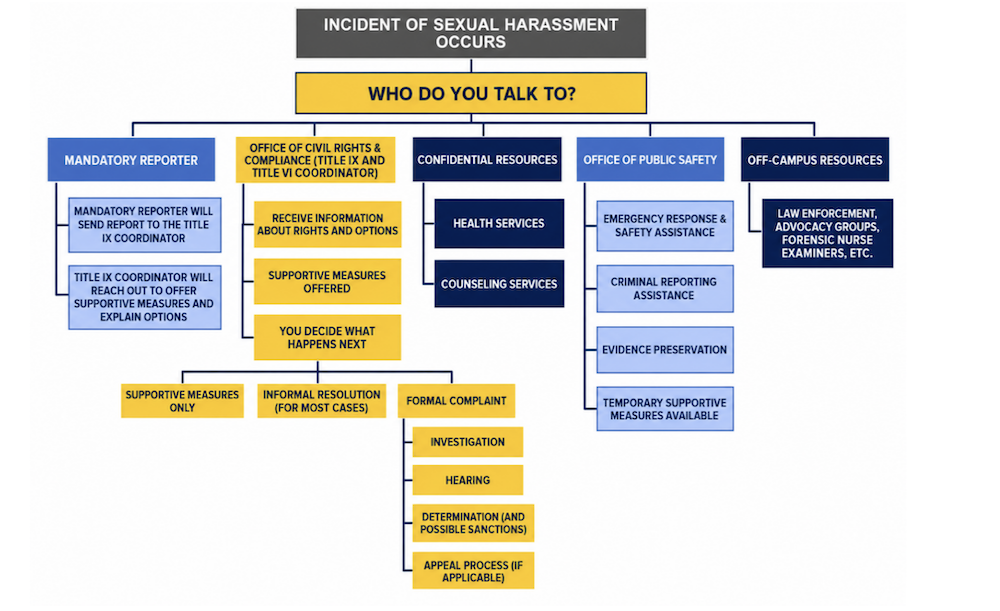
The figure below illustrates different options and pathways available after an incident of sexual harassment and/or retaliation occurs:
Time Frame for Resolution
The Procedures establish reasonably prompt time frames for the conclusion of the grievance process, including reasonably prompt time frames for filing and resolving appeals and informal resolution processes. In some circumstances, there may be temporary delays of the grievance process, or time frames may be extended for good cause. In those cases, the complainant and respondent will receive written notice of the delay or extension and the reasons for the action. “Good cause” may include considerations such as the absence of a party, a party’s advisor, or a witness; concurrent law enforcement activity; or the need for language assistance and/or other forms of accommodations related to an identified disability.
All time frames expressed in this Policy are meant to be guidelines rather than rigid requirements. Extenuating circumstances may arise that require the extension of time frames. Extenuating circumstances may include the complexity and scope of the allegations, the number of witnesses involved, the availability of the parties or witnesses, the effect of a concurrent criminal investigation, any intervening school break or vacation, or other unforeseen circumstances.
In general, a complainant and respondent can expect that the process will proceed according to the time frames provided in the Policy and Procedures. The College will keep all parties updated on the status of resolution procedures throughout the process. In the event that the investigation and resolution exceed this time frame, the College will notify all parties of the reason(s) for the delay and the expected adjustment in time frames. Best efforts will be made to complete the process in a timely manner by balancing principles of thoroughness and fundamental fairness with promptness.
Education and Prevention Programs
SMCM is committed to the prevention of sexual harassment through education and awareness programs. Throughout the year, programs designed to promote awareness are presented by a variety of campus resources. Prevention programs include an overview of the College’s policies and procedures, relevant definitions, including prohibited conduct, discussion of the impact of alcohol and illegal drug use, effective consent, safe and positive options for bystander intervention, and information about risk reduction.
Incoming first year students and new employees will receive primary prevention and awareness programming as part of their orientation. Returning students and employees will receive ongoing training on a periodic basis. The College’s Title IX Coordinator oversees the education and prevention calendar and tailors programming to campus needs and climate. All educational programs include a review of resources and reporting options available for students, faculty and staff.
The College’s Title IX Coordinator and Deputies, investigators, decision-makers, and any person who facilitates informal resolution processes (together, “Title IX Personnel”) will receive training on:
- The definition of sexual harassment;
- The scope of the College’s education program or activity;
- How to conduct an investigation and grievance process, including hearings, appeals, and informal resolution processes, as applicable; and
- How to serve impartially, including by avoiding prejudgment of the facts at issue, conflicts of interest, and bias.
Furthermore, decision-makers will receive training on any technology to be used at a live hearing and on issues of relevance of questions and evidence, including when questions and evidence about the
complainant’s sexual predisposition or prior sexual behavior are not relevant. Investigators will receive training on issues of relevance to create investigative reports that fairly summarize relevant evidence.
Training materials will not rely on sex stereotypes and will promote impartial investigations and adjudications of formal complaints of sexual harassment.
The College will maintain, for seven years, records of all materials used to train Title IX Personnel.
Agreements with Local Law Enforcement and Rape Crisis Programs
The College must, at a minimum, pursue formalized agreements with (1) the College’s local law enforcement
agency and (2) a State designated rape crisis program and/or federally recognized sexual assault coalition. Agreements with law enforcement agencies must comply with Title IX and clearly state when an institution will refer a matter to a local law enforcement agency. Agreements with rape crisis or sexual assault programs must formalize a commitment to provide trauma-informed services to victims of sexual assault and to
improve the institution’s overall response to sexual assault.
Campus Sexual Assault Climate Survey
At least every two (2) years, the College shall (1) develop an appropriate sexual assault campus climate survey using nationally recognized best practices for research and climate surveys, and (2) administer the sexual assault campus climate survey to students in accordance with the procedures set by the Maryland Higher Education Commission (MHEC). At least every two (2) years, the College shall submit to MHEC a report in accordance with the requirements set forth in Md. Code Ann. Educ. § 11-601(g).
Conflicts with Other Policies
To the extent that this Policy conflicts with any other College policy, procedure, handbook, faculty or employee bylaw, agreement, or process, this Policy shall prevail.