Why the Numbers Matter
By Patrice Darby, Director of Student Success Services
Office of Student Success Services (OS3)
College success is shaped by habits, engagement, and timely-decision making. There are some key numbers and calculations that students need to understand in order to be successful in their college career: the average number of credits they need to earn per semester to graduate in four years, how a GPA is calculated, and why a “W” is better than an “F”.
At St. Mary’s College of Maryland all students need to earn a minimum of 128 credits to graduate. If you divide those 128 credits by four years, then by two semesters each year, you get 16 credits per semester.

Many families are concerned that their students will take 16-18 credits their first semester. This is an appropriate amount of credits. Taking a semester with 18 credits balances out a semester at 14 credits so that students can still graduate in four years. A student who consistently takes 14 credits each semester will take four years, plus an extra semester and will still be short two credits!

“Sixteen to succeed” is what we tell students over and over to help them remember that they need to average 16 credits each semester to graduate in four years. In addition to earning at least 128 total credits, students must earn at least 44 credits that are at the 300- or 400-level, and have at least a 2.0 cumulative GPA.
Most people have a vague understanding of what a GPA is. The Grade Point Average (GPA) is calculated by multiplying the number of credits for a course by the quality points for the grade that is earned and then dividing that number by the total number of credits.
A grade-point average (GPA) is calculated on the basis of the following quality points:
A = 4.0
A- = 3.7
B+ = 3.3
B = 3.0
B- = 2.7
C+ = 2.3
C = 2.0
C- = 1.7
D+ = 1.3
D = 1
F = 0
What does this mean!? Let’s say a student is taking four classes. They have a B+ in FAKE101, which is four credits, an A in NOPE101, which is four credits, a B- in RISE101, which is four credits, and an F in HELP101, which is 1 credit. Below, you’ll see the points for each grade.
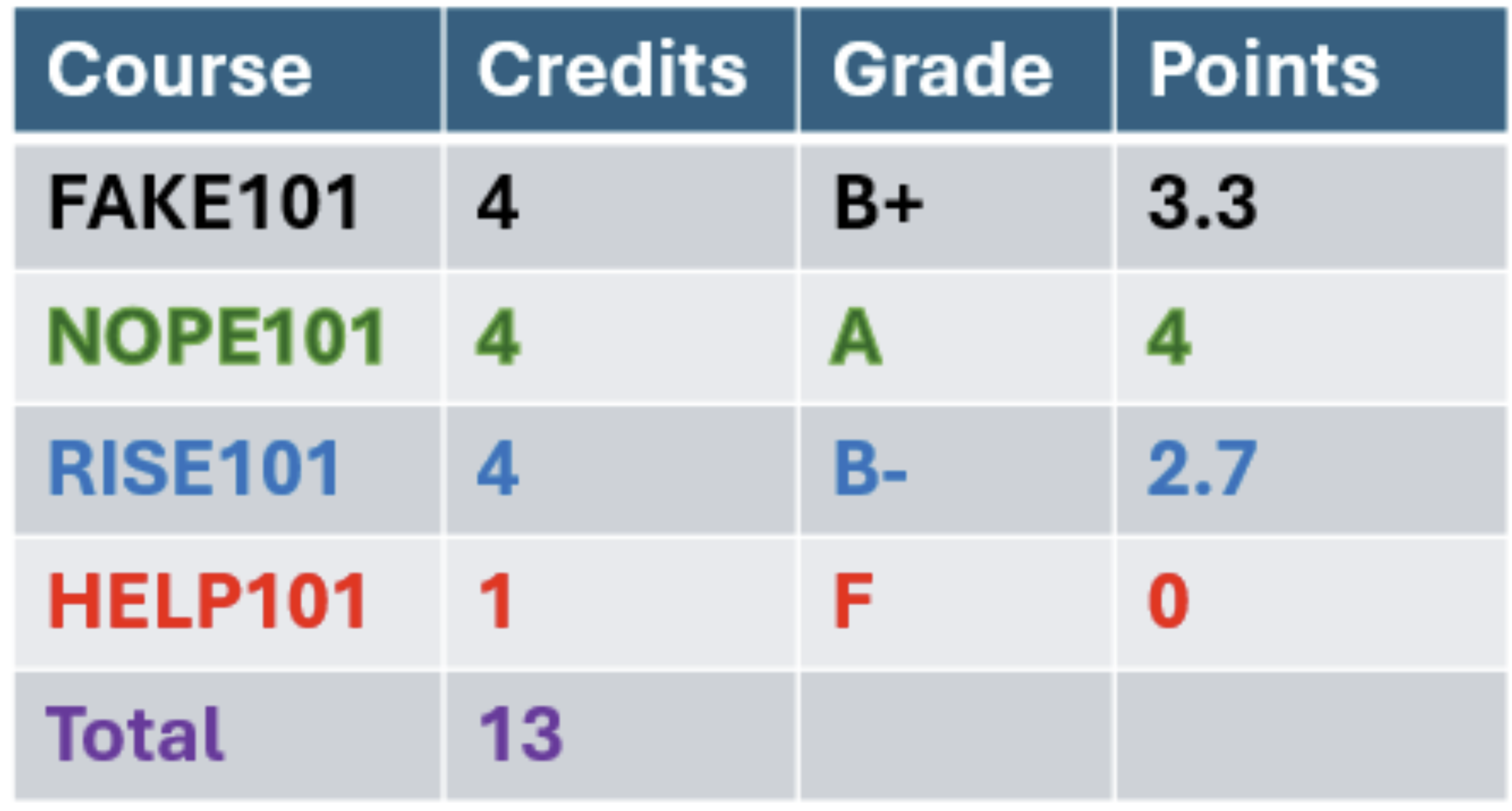
To calculate the GPA, we multiply the number of credits by the quality points associated with the letter grade and add that together for each class. Finally, we divide all of that by the total number of credits.
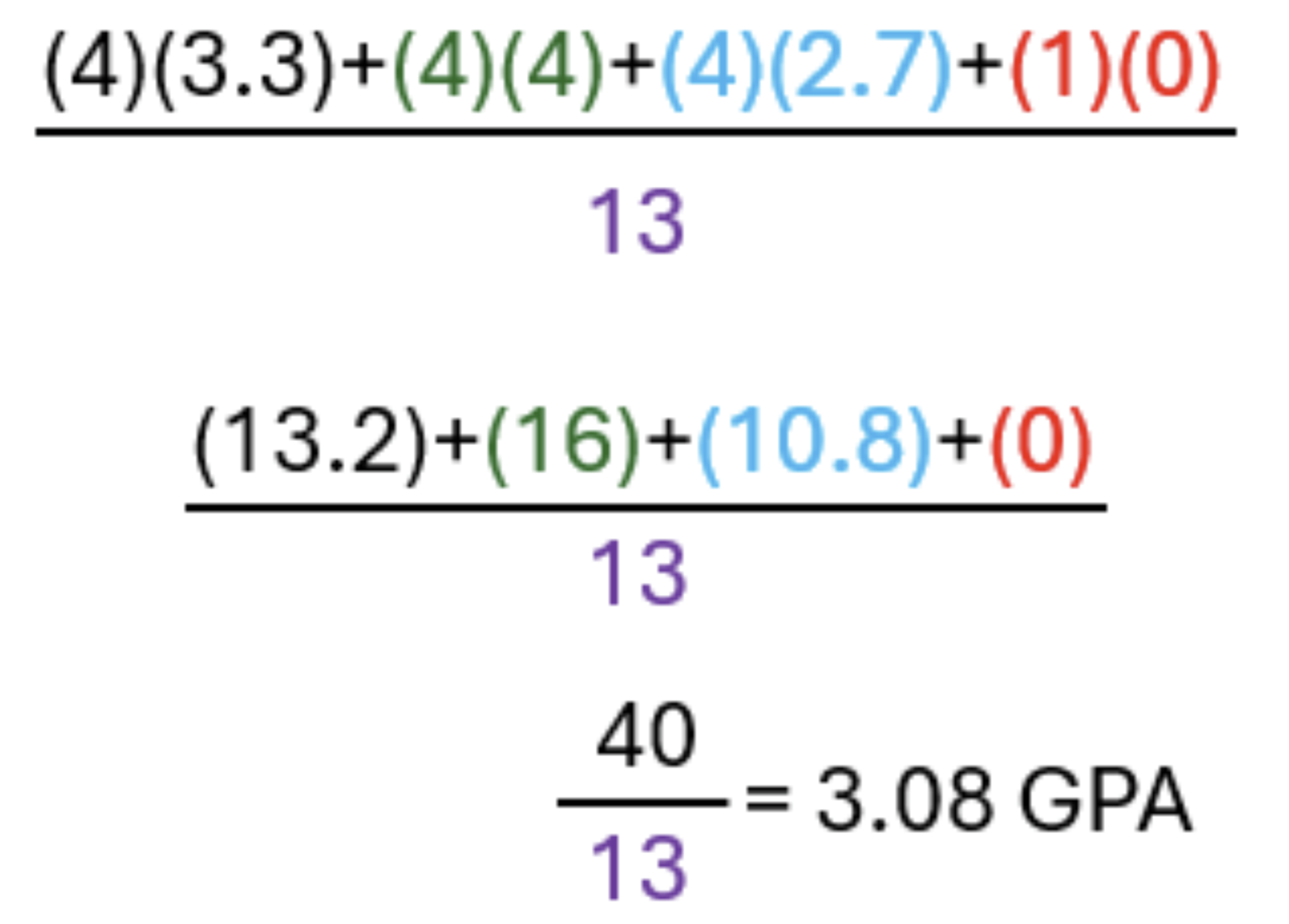
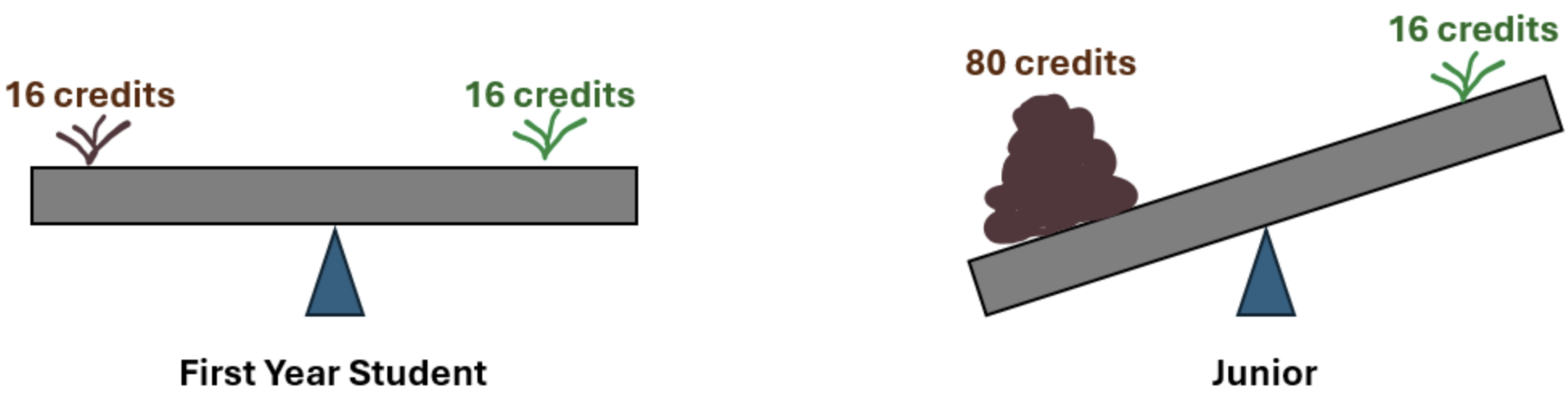
This process looks complicated, but there are two important things to understand. First, the grades of a class with fewer credits don’t affect the GPA as much as the grades in a class with more credits. Second, the bigger the number on the bottom is, the harder it is for a student to significantly change their cumulative GPA. First and second year students need to take their grades seriously because they have the greatest opportunity to move their GPA. A first year student who has earned 16 credits and has a 1.0 GPA can raise their cumulative GPA to a 2.0 by the end of the next 16 credit semester by earning a B average. A junior who has earned 80 credits and has a 1.0 GPA can only get their GPA up to a 1.34 by the end of the next 16 credit semester by earning a B average.