
Program Highlight
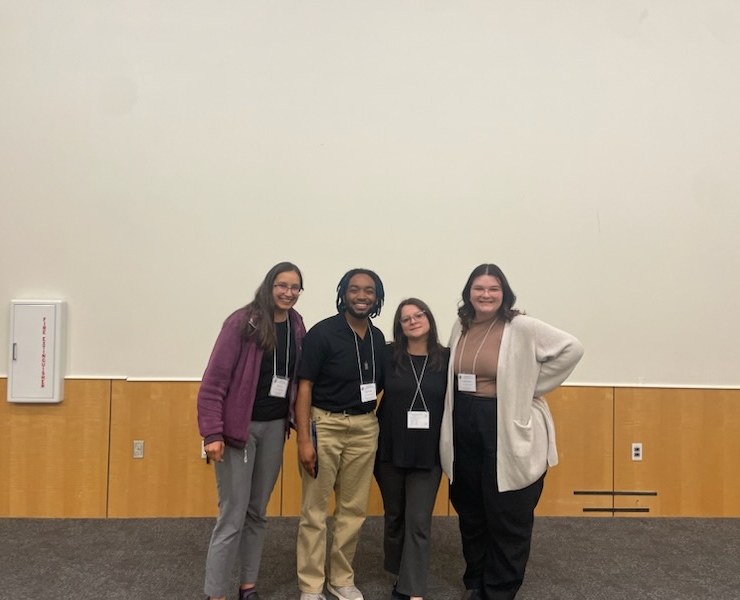
Katherine Socha accepting one of her two national awards at Mathfest. She's holding the Alder Award for excellence in teaching by a young mathematician and also won the Ford Award for her article "Circles in Circles: Creating a Mathematical Model of Surface Water Wave."
Student Spotlight
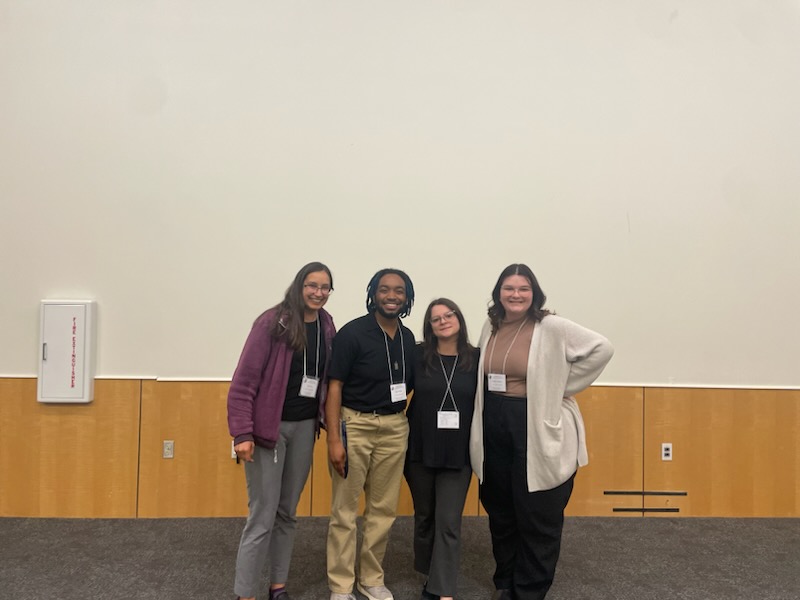
The 2008 SMCM REU students relaxing in front of the MAA's Carriage House with REU director Katherine Socha

"We Learned How to Think"
The wondrous world of mathematics was studied by early civilizations, systematically explored in ancient Greece, widened by the mathematicians of the intervening centuries, and put on solid logical foundations during the past two hundred years. Today, we are exploring many new branches of mathematics, solving old problems, formulating new ones, and steadily extending the boundaries of our knowledge. Without mathematics, there would be little technology in the modern world, no exploration of space or the subatomic realm, no advanced physics, chemistry, biology, or medicine. There would be no radio or television, no trains, no cars, no airplanes, no electric heat or light, and, of course, no computers, e-mail, or internet.
The mathematics program at St. Mary's introduces students into the miraculous world of mathematics at many levels. We broaden the horizons of the general college student, giving them insights into the types of reasoning that characterize our discipline and preparing them to lead examined lives as informed citizens. We acquaint students of the physical and social sciences with the tools necessary for their further studies. We provide our majors with a solid knowledge and understanding of abstract mathematics as well as some of its applications, thus preparing them for further studies, for teaching careers, and for future careers in government, business, or industry.
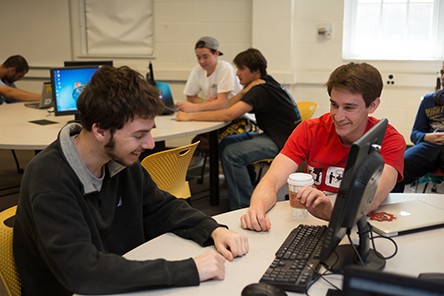
Our Computer Science program takes a "theory in action" approach, teaching the fundamentals of computing, critical and abstract thinking, problem solving, communication and teamwork skills. We demonstrate the applicability of these core ideas through a broad curriculum, experiential learning and undergraduate research. This prepares students for practice and for future learning whether at graduate school or in the workplace.
Most of our graduates are very successful in their careers. When they visit us years after graduation (and many do) and we ask them what was most important about their education at St. Mary's, a surprisingly large number respond: "We learned how to think".

